

Business English Training
Preply Business English Courses: Corporate Training Overview
A detailed look at Preply's corporate language solutions for businesses of all sizes
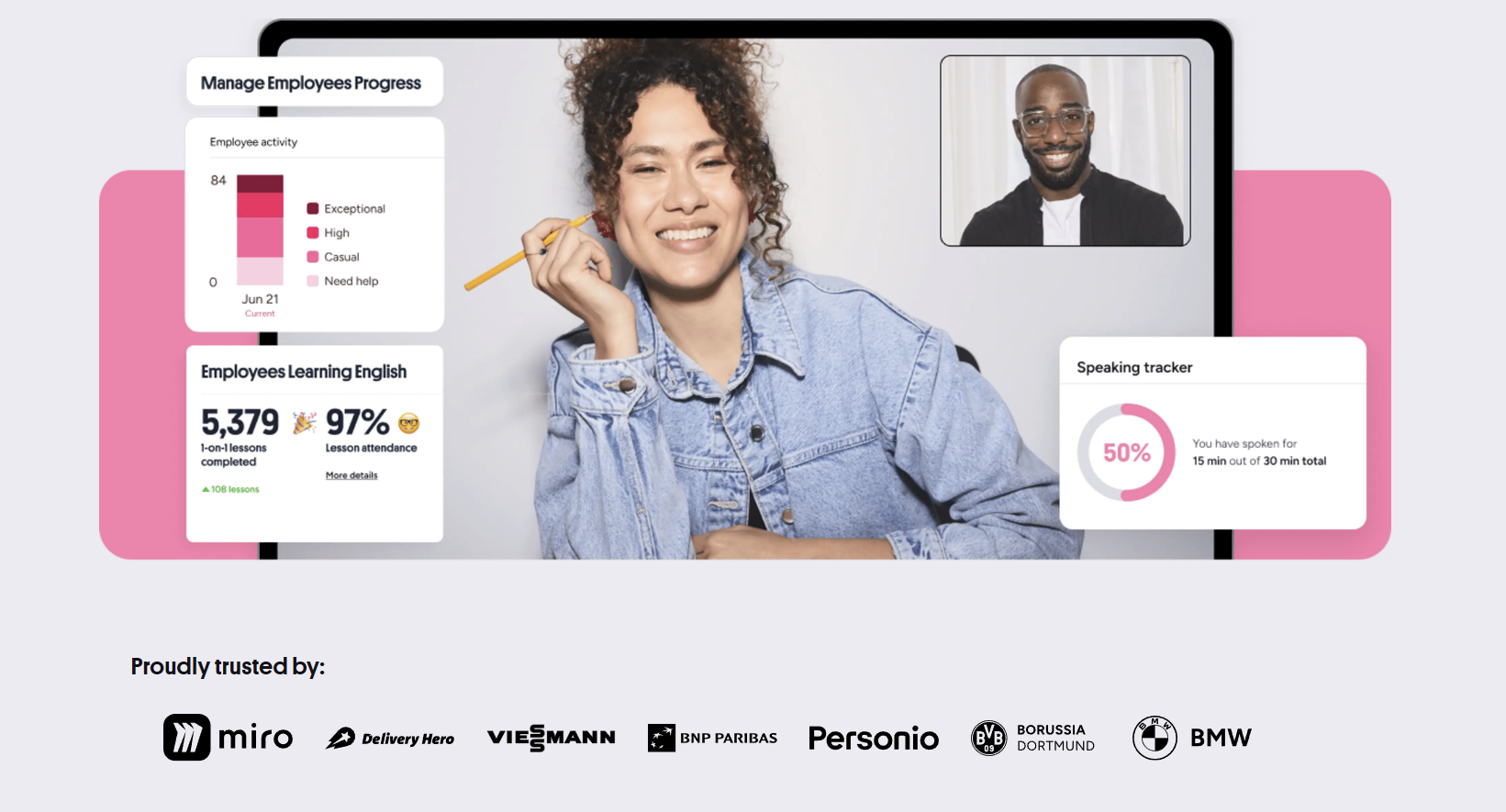
Preply has built a recognizable name in online language tutoring, but its business division operates differently from the consumer side. Companies looking for structured English training often find themselves comparing Preply against traditional language schools, corporate training providers, and newer B2B platforms. The core promise is straightforward: connect employees with qualified tutors for one-on-one lessons, handle the administrative overhead, and provide reporting that satisfies HR and L&D requirements.
Contents
- 1. What Preply Business English Offers Companies
- 2. How the Platform Works for Teams
- 3. Tutor Selection and Specialization
- 4. Learning Management and Progress Tracking
- 5. Pricing Structure for Corporate Plans
- 6. Integration and Administrative Features
- 7. Comparing Preply to Traditional Language Schools
- 8. Real Company Experiences and Results
- 9. Limitations to Consider
- 10. Getting Started with a Business Account
- 11. Final Assessment of Preply Business English
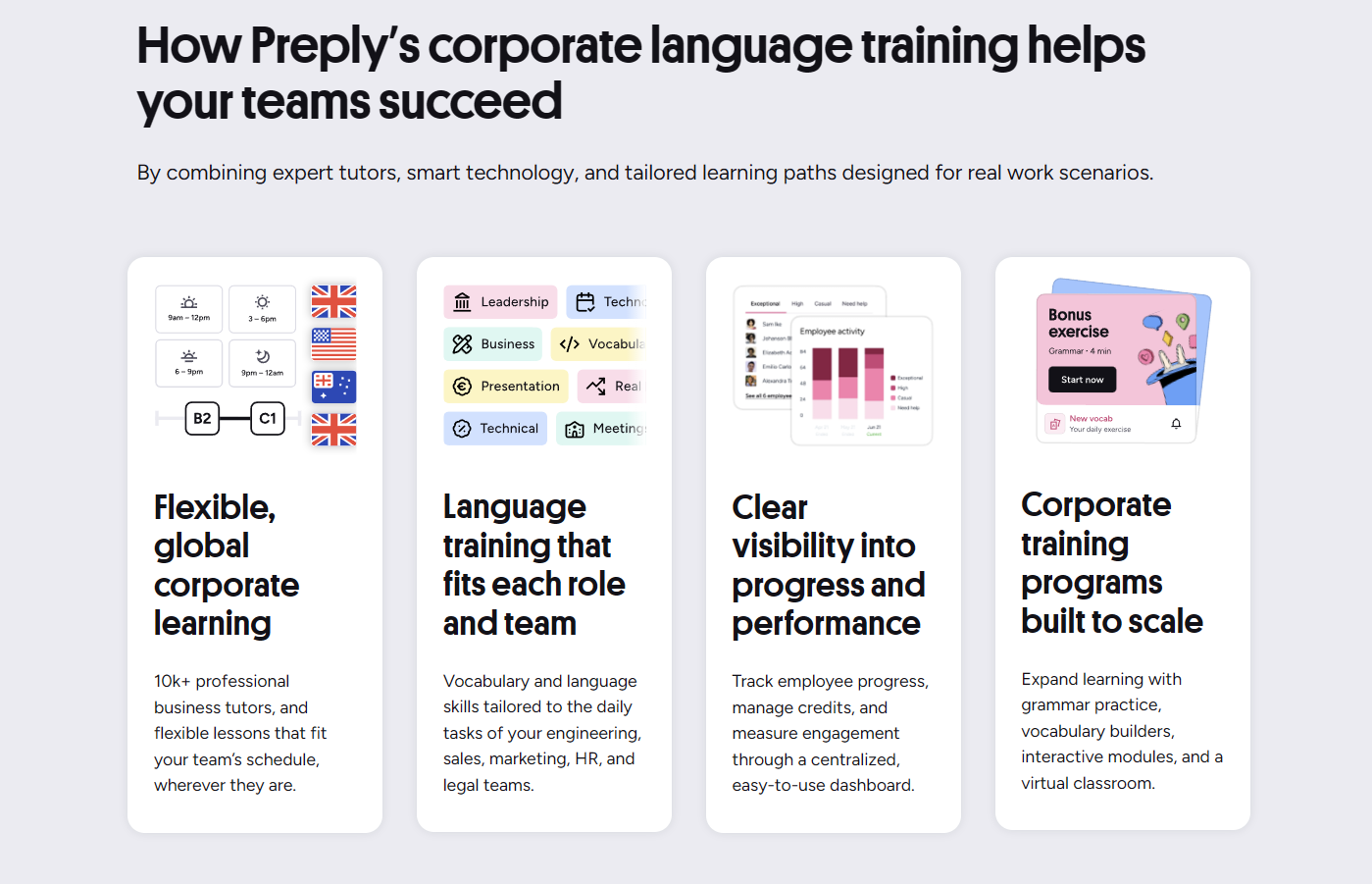
What makes the business offering distinct is not just volume licensing. The platform adds team management tools, centralized billing, progress dashboards, and account management support that individual learners never see. For organizations with distributed teams or hybrid workforces, the flexibility of scheduling across time zones becomes a practical advantage rather than a marketing bullet point.
This article examines how Preply Business English courses work in practice, where they fit in the corporate training landscape, and what decision-makers should evaluate before committing budget.
What Preply Business English Offers Companies
The business product centers on one-on-one video lessons with tutors who self-identify as having business English expertise. Unlike some competitors that assign tutors, Preply lets organizations or individual learners choose from the marketplace. Tutors set their own rates, and the platform takes a commission. Companies can fund a central budget that employees draw from, or allocate specific allowances per learner.
Course content is not standardized across the platform. Each tutor designs their own curriculum, materials, and assessment approach. This means a marketing team in Berlin and a sales team in São Paulo might follow completely different programs even within the same company account. For some organizations, this flexibility is the main appeal. For others, it creates inconsistency they would prefer to avoid.
- One-on-one lessons with tutor choice from a global marketplace
- Centralized billing and budget allocation across teams
- Admin dashboard for tracking attendance, hours used, and progress
- Dedicated account manager for enterprise plans
- Integration options with HRIS and LMS platforms
- Custom reporting for compliance and ROI measurement
The platform also supports group lessons for up to six participants, though these are less commonly used than individual sessions. Group sessions can work for onboarding cohorts or department-wide workshops, but scheduling becomes more complex with each added participant.
Preply positions itself as a solution for companies that need English training but lack the internal resources to run a program. The pitch emphasizes speed of deployment — a team can start lessons within days of account setup — and the breadth of tutor availability across time zones. Whether that translates to measurable skill improvement depends heavily on tutor selection and learner engagement.
How the Platform Works for Teams
From an administrator perspective, the onboarding flow is designed to be self-serve for smaller teams and guided for larger deployments. An admin creates the organization account, invites team members via email, and sets budget rules. Employees then receive access to the tutor marketplace filtered for business English specialists, though they can technically browse the full catalog.
Lesson scheduling happens directly between learner and tutor through the platform calendar. The system handles time zone conversion automatically, which matters for global teams. Lessons take place in Preply's built-in video classroom with screen sharing, chat, and a collaborative whiteboard. Sessions can be recorded if both parties consent, useful for review or compliance.
Progress tracking relies on tutor-reported assessments and the platform's own level test, which aligns loosely with CEFR frameworks. Admins see lesson frequency, hours completed, and tutor ratings. Deeper skill analytics — speaking accuracy, vocabulary growth, writing improvement — depend on individual tutors providing that data, which is not guaranteed.
Tutor Selection and Specialization
The tutor marketplace is Preply's core asset and its biggest variable. Over 30,000 tutors list business English as a specialty, but the designation is self-applied. A tutor who has taught three professionals in their career appears alongside someone with 15 years of corporate training experience and certifications in business communication.
Filters help narrow the pool: hourly rate, availability, native language, accent preference, and student ratings. The platform also surfaces tutors with specific industry experience — finance, tech, legal, healthcare — though the depth of that experience varies. Some tutors have genuine sector backgrounds; others have simply taught professionals in those fields.
Scroll horizontally to see all columns
| Filter Category | Available Options |
|---|---|
| Hourly Rate | $5–$100+ per hour, set by tutor |
| Specialization Tags | Business English, Interview Prep, Presentations, Negotiations, Industry-specific |
| Availability | Time zone, days of week, specific hours |
| Credentials | TEFL/TESOL, CELTA, DELTA, Business English certifications |
| Student Ratings | 4.0+, 4.5+, 4.8+ (out of 5.0) |
| Native Language | English, Spanish, German, French, 50+ others |
For companies that want more consistency, Preply offers a managed service tier where their team helps match learners with vetted tutors based on a needs assessment. This adds cost but reduces the trial-and-error period that often frustrates new learners. The trade-off is less direct control over tutor choice.
Tutor quality variance is the single biggest factor in whether a corporate program succeeds. The platform gives you tools to filter, but it cannot guarantee that a highly rated tutor matches your team's specific communication challenges.
Learning Management and Progress Tracking
The admin dashboard provides a bird's-eye view of program utilization. Key metrics include total hours booked, lessons completed, average tutor rating, and budget consumption. Individual learner profiles show lesson history, upcoming sessions, and tutor feedback summaries. Data exports are available in CSV format for integration with internal reporting.
Preply's level test serves as a baseline and periodic checkpoint. It assesses grammar, vocabulary, reading, and listening through adaptive multiple-choice questions. Speaking and writing are not evaluated in the automated test. Some tutors conduct their own speaking assessments during initial lessons, but there is no standardized speaking benchmark across the platform.
For enterprise clients, Preply assigns a customer success manager who helps design reporting cadences and can pull custom data cuts. Smaller business accounts rely on the self-serve dashboard. The difference in support level is one of the clearer dividing lines between plan tiers.
Integration with HRIS systems (Workday, BambooHR, Personio) and LMS platforms (Cornerstone, Docebo, SAP SuccessFactors) is available via API for enterprise plans. Setup requires technical resources on both sides. For companies without integration capacity, manual CSV uploads remain the fallback.
Pricing Structure for Corporate Plans
Preply does not publish fixed pricing for business accounts. The model combines tutor fees (set individually, typically $15–$75 per hour for business English specialists) with a platform fee that varies by contract volume and commitment length. Smaller teams often pay month-to-month at standard rates. Enterprise agreements usually involve annual commitments with volume discounts and dedicated support.
A typical mid-market deployment might budget $200–$400 per employee per month for weekly lessons, though actual spend depends heavily on tutor selection and lesson frequency. Some companies cap tutor rates at $40/hour to control costs; others authorize premium tutors for leadership development tracks.
Scroll horizontally to see all columns
| Plan Tier | Typical Commitment | Platform Fee | Support Level |
|---|---|---|---|
| Team (2–20 users) | Monthly | Standard commission | Email/chat support |
| Business (20–100 users) | Annual | Volume discount | Dedicated CSM |
| Enterprise (100+ users) | Multi-year | Custom pricing | CSM + implementation |
Hidden costs can appear in tutor changes (learners often trial 2–3 tutors before settling), lesson cancellations within 24-hour windows (some tutors charge), and the administrative time required to manage the program internally. Companies should budget 10–15% above tutor fees for platform and management overhead.
Integration and Administrative Features
The administrative toolkit covers the basics well: user provisioning via CSV or SCIM, role-based access (admin, manager, learner), budget allocation by department or cost center, and automated invoice generation. Single sign-on (SAML/OIDC) is available for enterprise tiers. The platform also supports custom domains for the learner portal, which some companies prefer for branding consistency.
One practical feature is the ability to create learning groups — for example, "EMEA Sales Q3 Cohort" — with shared goals, recommended tutors, and group-level reporting. Managers can monitor their direct reports' progress without full admin access. This middle management layer is often missing in competitor platforms.
- SCIM provisioning for automated user lifecycle management
- SAML/OIDC single sign-on for enterprise plans
- Custom domain and branding for learner portal
- Department-level budget allocation with rollover rules
- Manager view for team progress monitoring
- Automated invoice consolidation across entities
The mobile app mirrors most desktop functionality for learners, including lesson scheduling, chat with tutors, and access to lesson materials. Admins cannot manage budgets or users from the app — that remains desktop-only. For a workforce that travels frequently, the mobile experience is adequate but not a full replacement.

API access allows custom integrations, but documentation is not publicly available — it's shared during enterprise onboarding. Companies with internal development teams can build workflows like automatic budget top-ups based on utilization or Slack notifications for upcoming lessons. The API rate limits are generous enough for most use cases.
Comparing Preply to Traditional Language Schools
Traditional corporate language providers (Berlitz, EF, Learnlight, local schools) typically offer structured curricula, certified teachers, cohort-based classes, and guaranteed outcomes tied to frameworks like CEFR. They also cost significantly more — often 2–3x per learner hour — and require longer lead times to launch.
Preply trades curriculum standardization for tutor choice and scheduling flexibility. A traditional provider assigns a teacher and a syllabus. Preply lets the learner or manager choose. For motivated professionals who know what they need — presentation coaching, technical vocabulary, interview prep — the marketplace model can be more efficient. For beginners or learners who need structure, the lack of a defined path can lead to drift.
Scroll horizontally to see all columns
| Dimension | Preply Business | Traditional Providers |
|---|---|---|
| Curriculum | Tutor-defined, flexible | Standardized, certified |
| Teacher Selection | Learner/company choice | Provider assigned |
| Scheduling | On-demand, 24/7 | Fixed cohorts or limited slots |
| Cost per Hour | $15–$75 (tutor) + platform fee | $80–$200+ all-inclusive |
| Deployment Speed | Days | Weeks to months |
| Progress Standards | Variable, tutor-dependent | CEFR-aligned, assessed |
| Scalability | High (global tutor pool) | Limited by teacher capacity |
The comparison is not purely financial. Traditional providers handle pedagogical design, quality assurance, and compliance documentation — work that falls to the company or individual tutors on Preply. For regulated industries or companies with strict training audit requirements, that difference matters.
Real Company Experiences and Results
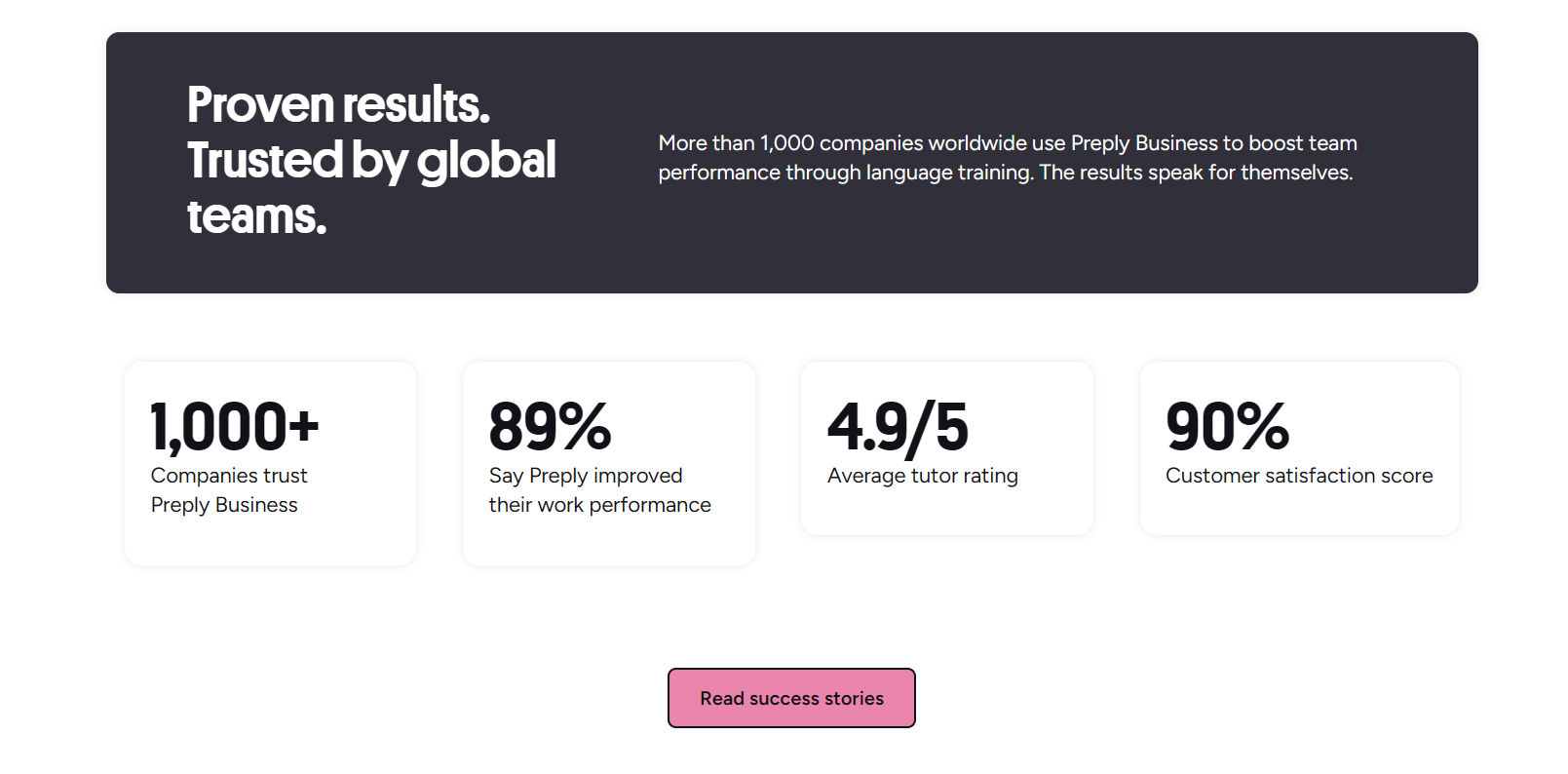
Public case studies from Preply feature companies like TransferWise (now Wise), Revolut, and various tech scale-ups. The common pattern: rapid deployment for international teams, high initial engagement, and measurable improvement in speaking confidence. Hard metrics on business impact — deal closure rates, support ticket resolution, promotion readiness — are rarely published.
Feedback from learning managers on review platforms highlights three recurring themes. First, the platform is easy to administer. Second, tutor quality varies enough that some learners have frustrating experiences. Third, the lack of a unified curriculum makes it difficult to report consistent outcomes to leadership.
We saw great results for our senior engineers who needed technical presentation skills. The same program was less effective for junior support staff who needed foundational business English. The platform works best when learners already know their gaps.
Retention data from Preply suggests that learners who complete 20+ lessons show measurable level test improvement. However, completion rates for voluntary corporate programs often hover around 40–60%. Mandatory programs see higher completion but lower satisfaction scores. The sweet spot appears to be voluntary enrollment with manager endorsement and clear goal-setting.
Companies that treat Preply as a benefit — "here's a budget, learn what you want" — get higher satisfaction but less strategic alignment. Companies that treat it as a program — "here's a budget for these specific skills, with these tutors, measured this way" — get better business outcomes but require more internal management.
Limitations to Consider
No platform fits every use case. Preply's business product has clear constraints that appear in almost every evaluation.
- No guaranteed tutor consistency — tutors can leave the platform or raise rates mid-contract
- Curriculum fragmentation across tutors makes cohort-level reporting unreliable
- Speaking and writing assessment lacks standardization
- Group lesson functionality is basic compared to dedicated virtual classroom tools
- API and integration documentation is not public, slowing technical evaluation
- Platform fee structure is opaque without sales engagement
- Data residency options are limited (primary hosting in US/EU, no regional selection)
- No built-in content library — tutors bring or create their own materials
For companies needing accredited certification, Preply does not issue recognized credentials. Some tutors can prepare learners for IELTS, TOEIC, or Cambridge exams, but the platform itself is not an exam center. If your compliance framework requires certified training hours, this is a gap.
Getting Started with a Business Account
The fastest path is a pilot. Most companies start with 5–15 learners for 2–3 months, using a monthly team plan to avoid long-term commitment. Define success criteria upfront: lesson completion rate, level test improvement, learner satisfaction score, or business-specific metrics like presentation readiness.
During the pilot, assign an internal program owner — usually someone in L&D, HR, or a department head. Their role is to monitor engagement, help learners select tutors, and gather qualitative feedback. Without an owner, pilots tend to drift into low utilization.
- Define 2–3 measurable pilot objectives before launch
- Select pilot participants who have clear, immediate English needs
- Set a minimum lesson frequency expectation (weekly recommended)
- Schedule mid-pilot check-ins with each learner
- Collect structured feedback at 30, 60, and 90 days
- Compare outcomes against your success criteria before scaling
Preply's sales team typically engages once a company exceeds 20 seats or requests enterprise features. The conversation shifts to volume pricing, SLA commitments, implementation support, and contract terms. Smaller teams can self-serve entirely through the website.
Final Assessment of Preply Business English
Preply Business English courses solve a specific problem well: giving motivated professionals access to qualified tutors on their schedule, with the administrative infrastructure companies need. The platform is not a complete learning management system, nor does it replace structured language programs for foundational skills. It works best as a targeted tool for intermediate-to-advanced learners who need practice in specific business contexts — negotiations, presentations, client calls, technical discussions.
The marketplace model means outcomes depend on tutor selection. Companies that invest in matching — whether through Preply's managed service or internal vetting — see better results. Companies that hand learners a budget and walk away get mixed engagement. The platform enables both approaches but rewards the former.
Frequently Asked Questions
How does Preply Business differ from regular Preply?
Preply Business adds centralized billing, admin dashboards, team management tools, dedicated support for larger accounts, and volume pricing. The tutor marketplace and lesson experience are the same.
Can we require all employees to use the same tutor or curriculum?
You can recommend specific tutors and set rate limits, but you cannot mandate a single tutor or curriculum across the organization. Each learner chooses their tutor.
What happens if a tutor leaves the platform mid-contract?
The learner must select a new tutor. Preply does not guarantee tutor continuity. Enterprise accounts receive transition support from their customer success manager.
Does Preply provide certificates for completed courses?
Preply issues completion certificates showing hours studied, but these are not accredited or aligned with official frameworks like CEFR. For certified results, learners must take external exams.
Can we integrate Preply with our HRIS or LMS?
Yes, via API for enterprise plans. Supported systems include Workday, BambooHR, Cornerstone, and others. SCIM provisioning and SAML SSO are also available at the enterprise tier.
What is the minimum contract size for business plans?
Team plans start at 2 users with monthly billing. No annual commitment is required below the Business tier (typically 20+ users).
How are tutor rates determined?
Tutors set their own hourly rates, typically $15–$75 for business English specialists. Companies can set maximum rate limits per department or user.
Is there a free trial for business accounts?
Preply occasionally offers pilot programs for qualified companies. Standard accounts can start with a small monthly commitment and cancel anytime.