
Language Learning Assessment
Preply English Vocabulary Test: Complete Guide
Everything you need to know about Preply's vocabulary assessment and how it fits into your language learning journey.
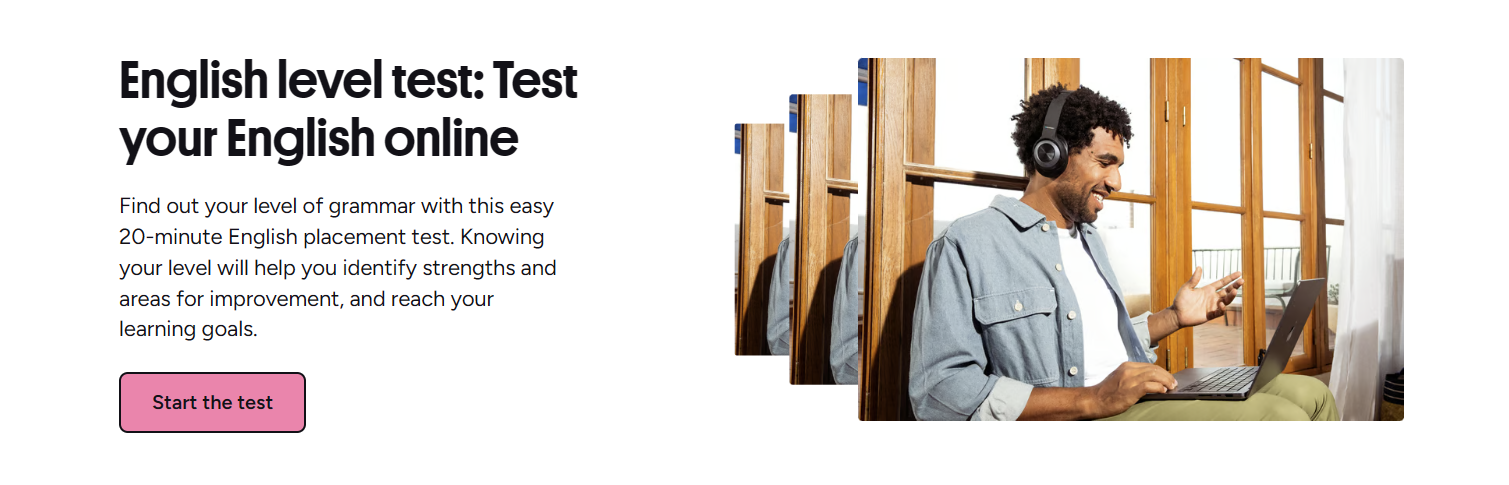
Preply's English vocabulary test serves as a quick placement tool that helps match students with tutors at the right level. The assessment takes roughly ten minutes and covers word recognition, usage, and context across common topics. Unlike comprehensive exams such as IELTS or TOEFL, this test focuses specifically on vocabulary breadth rather than grammar, listening, or speaking skills.
Contents
- 1. What the Preply Vocabulary Test Actually Measures
- 2. How to Take the Test and What to Expect
- 3. Test Format and Question Types in Detail
- 4. Interpreting Your Score and Percentile
- 5. How Tutors Use Your Vocabulary Level
- 6. Preply Vocabulary Test Compared to Other Placement Tools
- 7. Using the Vocabulary Guide Alongside the Test
- 8. Limitations You Should Know
- 9. Retaking the Test and Tracking Growth
- 10. Common Questions About the Preply Vocabulary Test
- 11. Final Assessment of Preply English Vocabulary Test
Many learners take the test when they first create a Preply account, though it's also available later from the dashboard. The results feed directly into the tutor recommendation algorithm, which filters instructors based on the proficiency band you land in. A beginner score surfaces tutors who specialize in foundational vocabulary and basic conversation, while an advanced score brings up coaches experienced with academic, business, or nuanced idiomatic English.
The test is free and requires no commitment to book lessons afterward. You can retake it after a period of study to see measurable progress, though Preply spaces out retake eligibility to prevent gaming the system. Results display as a CEFR-aligned level — A1 through C2 — along with a percentile ranking against other test-takers.
What the Preply Vocabulary Test Actually Measures
The assessment draws from a bank of several thousand words mapped to CEFR frequency bands. Questions present target words in isolation, in sentences, or in short paragraphs. You might select a synonym, choose the correct collocation, fill a gap, or identify the odd word out. The adaptive engine adjusts difficulty in real time: answer a cluster of B1 items correctly and the next set shifts toward B2; miss several and it drops back to A2.
Because the test is vocabulary-only, it does not capture grammar control, pronunciation, listening comprehension, or writing ability. A student who reads extensively but rarely speaks may score higher than their functional speaking level suggests. Conversely, someone with strong conversational fluency but limited academic vocabulary could score lower than their actual communication effectiveness. Treat the result as a vocabulary snapshot, not a full proficiency certificate.
Preply states the test correlates reasonably well with standard vocabulary size estimates — roughly 1,000 word families at A2, 3,000 at B1, 5,000 at B2, 8,000 at C1, and beyond 10,000 at C2. These numbers align with research from Nation and Schmitt, though the test's proprietary item bank means exact mappings aren't publicly validated.
How to Take the Test and What to Expect
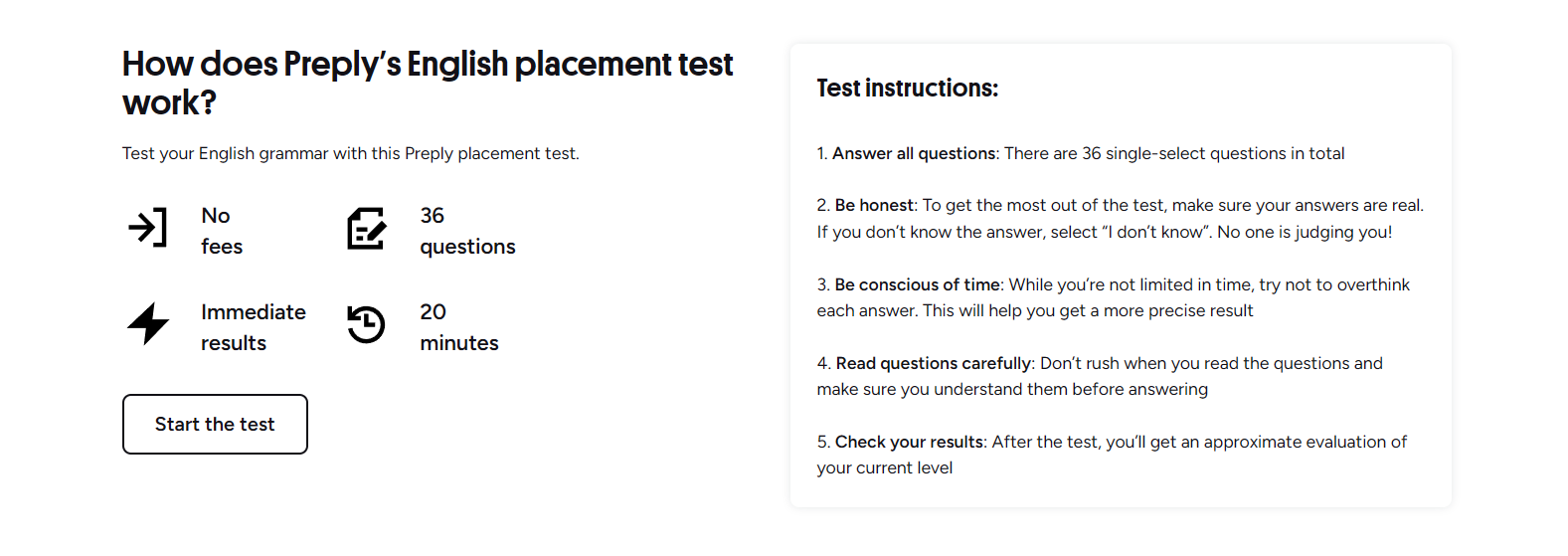
Log into your Preply account, open the menu, and select "English Level Test" or "Vocabulary Test" — labels vary slightly by platform version. The test launches in a full-screen modal with a progress bar. No audio plays; everything is text-based. You'll see one question at a time with four answer choices. There's no timer per question, but the session times out after twenty minutes of inactivity.
Answer honestly. Guessing randomly on items you don't know can inflate your level temporarily, which only leads to mismatched tutor suggestions and frustration in early lessons. If you're unsure, the "I don't know" option (when available) feeds the algorithm better data than a lucky guess. The test typically serves 25 to 35 questions depending on how quickly the adaptive engine converges on a stable level estimate.
After the final question, results appear immediately. You'll see your CEFR level, a brief descriptor ("Independent user — can understand main ideas of complex text"), and a percentile. The results page also shows a "Find tutors for your level" button that pre-filters the marketplace. You can dismiss the results and browse all tutors manually if you prefer.
Test Format and Question Types in Detail
The item pool rotates across several formats. Synonym selection asks you to pick the word closest in meaning to a target — for example, "rapid" with options like quick, slow, loud, quiet. Collocation questions test word partnerships: "make a decision" versus "do a decision." Gap-fill items present a sentence with a missing word and four candidates, only one of which fits both grammatically and semantically. Odd-one-out tasks give four words where three share a semantic field or register and one doesn't belong.
Higher levels introduce register awareness — distinguishing formal from informal equivalents ("purchase" vs. "buy"), recognizing academic vocabulary ("hypothesis," "methodology"), and identifying idiomatic phrases where meaning isn't compositional ("carry out" vs. "carry"). The test also samples domain-specific vocabulary at C1 and C2: business, legal, medical, and academic terms that rarely appear in general conversation.
Scroll horizontally to see all columns
| CEFR Level | Dominant Question Types | Vocabulary Focus |
|---|---|---|
| A1–A2 | Picture matching, basic synonyms, simple gap-fill | High-frequency concrete nouns, verbs, adjectives |
| B1 | Collocation choice, context gap-fill, odd-one-out | Phrasal verbs, common idioms, topic vocabulary |
| B2 | Register distinction, academic word forms, nuance | Abstract nouns, formal equivalents, word families |
| C1–C2 | Domain-specific, low-frequency, idiomatic, metaphorical | Specialized terminology, subtle connotation, register |
The adaptive logic means you won't see every type at every level. A1 test-takers rarely encounter register questions; C2 test-takers skip picture matching entirely. This keeps the test efficient but also means the diagnostic granularity within a level is limited — you get a band, not a detailed subskill profile.
Interpreting Your Score and Percentile
The CEFR band is the headline result. A1 and A2 indicate basic user — you know enough words for simple daily interactions but lack range for extended discourse. B1 and B2 mark independent users — you can handle most travel, work, and study situations with some circumlocution. C1 and C2 reflect proficient users — you operate effectively in demanding academic or professional contexts with precision and nuance.
The percentile compares you to other Preply test-takers, not the global English-learning population. Since Preply's user base skews toward motivated learners actively seeking tutors, percentiles tend to be lower than they would be against a general sample. A 60th percentile B2 on Preply might correspond to a higher percentile in a broader cohort. Don't overinterpret small percentile differences; the bands are the actionable signal.
A vocabulary band tells you which tutors will understand your gaps. It doesn't tell you how well you communicate.
Preply also breaks down performance by topic category — travel, business, technology, daily life, academic — showing relative strengths. These sub-scores are directional only; they're based on fewer items per category and carry more measurement error. Use them as rough guides for lesson focus, not definitive diagnostics.
If your result feels off — either too high or too low — consider factors like test fatigue, unfamiliar question formats, or a bad day. The test is a snapshot. Preply allows retakes after thirty days, which is a reasonable interval for genuine vocabulary growth to show up. Cramming word lists the night before won't move the needle meaningfully; the test samples too broadly for short-term memorization to help.
How Tutors Use Your Vocabulary Level
When you book a trial lesson, the tutor sees your self-reported level and your test result if you've taken it. Experienced tutors treat the test as a starting hypothesis, not ground truth. In the first session, they'll typically run a quick spoken needs analysis — asking about goals, checking comfort with spontaneous speech, and probing vocabulary in conversation. A tutor who relies solely on the test score without verifying it in dialogue is skipping a basic diagnostic step.
Tutors also use the topic-area breakdown to plan initial lessons. If your business vocabulary lags behind your general score, a business English tutor might prioritize workplace collocations and email phrases early on. If academic vocabulary is strong but everyday idioms are weak, a conversation-focused tutor might build lessons around phrasal verbs and colloquial expressions. The test data enables this targeting from day one.
Some tutors ignore the test entirely, preferring their own placement conversation. That's valid — especially for speaking-focused goals where vocabulary breadth matters less than fluency and repair strategies. If a tutor dismisses the test without explanation, ask why. Their reasoning reveals their teaching philosophy.
Preply Vocabulary Test Compared to Other Placement Tools
The Preply test sits between quick self-assessment grids (like the CEFR self-evaluation checklist) and full standardized exams. It's more structured than a checklist but far shorter than Oxford Online Placement Test, Cambridge English Placement Test, or Duolingo English Test. Those alternatives take 45 to 60 minutes and assess multiple skills; Preply's vocabulary test takes ten minutes and assesses one.
Scroll horizontally to see all columns
| Tool | Duration | Skills Tested | Cost | Best For |
|---|---|---|---|---|
| Preply Vocabulary Test | 10 min | Vocabulary only | Free | Tutor matching on Preply |
| Oxford Online Placement | 45–60 min | Grammar, vocab, listening | Paid | Course placement, progress tracking |
| Cambridge English Placement | 30–45 min | Reading, listening, grammar | Paid | Exam preparation planning |
| Duolingo English Test | 60 min | All four skills | Paid | University admission, certification |
| CEFR Self-Assessment Grid | 5 min | Self-report all skills | Free | Rough orientation only |
If you need a certificate for visa, university, or employer requirements, Preply's test doesn't qualify. It's an internal placement tool. Some learners take both — a standardized test for official purposes and Preply's test for tutor matching. The results usually align within one CEFR band, though vocabulary-only scores can deviate more for learners with unbalanced profiles.
Using the Vocabulary Guide Alongside the Test
Preply's English Vocabulary Guide — a separate resource in the learning hub — organizes words by topic, level, and function. After taking the test, the guide becomes more useful because you know which bands to prioritize. If you scored B1, the guide's B1–B2 transition lists (phrasal verbs for work, academic word list starters, common collocations) give you a structured self-study path between lessons.
The guide includes spaced-repetition flashcards, example sentences with audio, and mini-quizzes. It's not a replacement for tutor-led practice — productive vocabulary requires output and feedback — but it's a solid supplement for receptive growth. Tutors often assign specific guide sections as homework aligned with lesson topics.
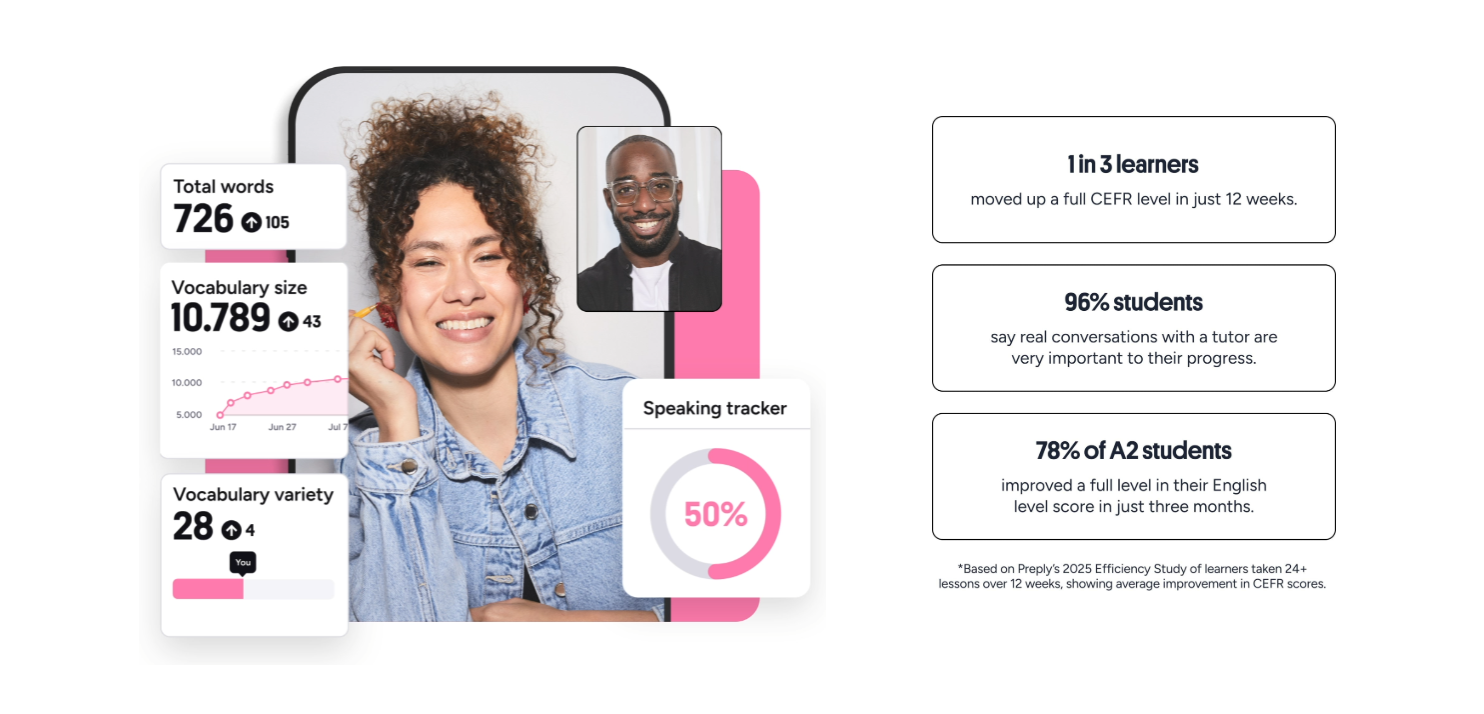
Progress tracking in the Preply dashboard combines test retakes, guide completion, and tutor-reported gains. The vocabulary metric updates when you retake the test or when a tutor marks vocabulary objectives as achieved in lesson notes. This multi-source approach reduces reliance on any single measure, though it still centers on vocabulary breadth rather than depth or productive control.
Limitations You Should Know
The test has blind spots. It doesn't measure how quickly you retrieve words in real-time conversation — a critical component of fluency. It doesn't assess collocational range in production, only recognition. It doesn't capture morphological flexibility (knowing "decide," "decision," "decisive," "decisively" as a family). And it has no speaking or writing component, so pronunciation, intonation, and orthographic vocabulary remain invisible.
The item bank, while large, inevitably reflects the topics Preply's content team prioritized. Some niche professional domains — maritime English, aviation phraseology, specific medical specialties — have sparse coverage. If your goal is highly specialized, the test's general vocabulary focus may misplace you. Discuss this with a domain-expert tutor during the trial lesson.
Vocabulary recognition is necessary but not sufficient for communication. The test measures the necessary part well; the sufficient part requires a tutor.
There's also a ceiling effect. The test caps at C2, but C2 encompasses a massive range — from "comfortable in most professional settings" to "near-native nuance in literary and technical discourse." Two C2 scorers may have vastly different functional vocabularies. The test doesn't differentiate within C2. For high-level learners, a tutor's qualitative judgment matters more than the band.
Retaking the Test and Tracking Growth
Preply enforces a thirty-day cooldown between attempts. This prevents score inflation from short-term memory of test items and encourages genuine study between retakes. The cooldown applies per account, not per device or browser. You'll see a countdown on the test launch screen if you're within the window.
Meaningful vocabulary growth takes time. Research suggests learners need roughly 100–150 hours of guided input and output to move one CEFR band at the intermediate levels, more at advanced levels. A single band jump in thirty days is possible with intensive study (daily lessons plus self-study), but half-band improvements are more typical. Don't expect dramatic shifts monthly.
When you retake, the results page shows a comparison view — previous band, current band, and a trend arrow. Tutors can see this history if you share it. Some tutors request a retake before a course milestone (exam prep, job interview) to calibrate final preparation. The comparison view also helps you decide whether to increase lesson frequency or adjust self-study focus.
Common Questions About the Preply Vocabulary Test
Learners often ask whether the test is mandatory. It's not — you can browse and book tutors without ever taking it. However, skipping it means the platform's matching algorithm relies only on your self-selected level, which many learners over- or under-estimate. The test adds an objective data point that improves match quality, especially for your first few tutor searches.
Another frequent question: does the test cost money? No, it's free for all registered users, including free accounts. There's no paywall, no trial expiration, and no limit on how many times you can take it over the long term — only the thirty-day cooldown between attempts.
Some wonder if tutors can see their exact answers. They cannot. Tutors see only the final CEFR band, percentile, and topic-area summary. Individual responses remain private. This protects test integrity (preventing answer-key sharing) and respects learner privacy.
A practical question: can you pause the test? The session times out after twenty minutes of inactivity, but you can close the modal and resume later if you return within that window. Your progress saves per question. If the session expires, you start fresh — no penalty, just a new adaptive sequence.
Frequently Asked Questions
Is the Preply English vocabulary test required to book lessons?
No. You can book tutors without taking the test, but the results help the platform recommend instructors matched to your level.
How long does the vocabulary test take to complete?
Most people finish in 8–12 minutes. The test adapts to your responses, so the exact number of questions varies.
Can I retake the test if I think my score is inaccurate?
Yes, but you must wait 30 days between attempts. This ensures the retake reflects actual vocabulary growth rather than test familiarity.
Does the test give me a certificate I can use for jobs or university?
No. It's an internal placement tool for tutor matching only. For official certification, you need exams like IELTS, TOEFL, or Cambridge English.
Will my tutor see my individual test answers?
No. Tutors see only your CEFR band, percentile, and topic-area summary. Specific responses stay private.
What if I score much higher or lower than I expected?
Discuss it with your tutor in the trial lesson. They'll run a quick spoken check and adjust materials accordingly. The test is a starting point, not a final verdict.
Does the vocabulary test cover business or academic English specifically?
Higher levels (B2–C2) include some business and academic vocabulary, but the test is general-purpose. For specialized domains, work with a tutor who teaches that variety.
Final Assessment of Preply English Vocabulary Test
The Preply English vocabulary test does what it's designed for: a fast, free, vocabulary-focused placement that feeds tutor matching. It's not a proficiency exam, a certificate, or a diagnostic deep-dive. Its value lies in giving tutors a reasonable starting hypothesis and giving learners a structured entry point into the platform's ecosystem. Used that way — as a conversation starter, not a verdict — it works well.
The main risk is overinterpretation. Learners sometimes treat the band as a fixed identity ("I'm a B1 student") rather than a fluid estimate. Tutors who lean on it too heavily may under-challenge or over-challenge in early lessons. The best outcomes come when both parties treat the score as provisional and verify it through actual interaction. Take the test, note the band, then let the first few lessons refine the picture.
If you're serious about vocabulary growth, pair the test with the vocabulary guide and regular tutor feedback. The test measures breadth; the guide builds it; the tutor ensures you can actually use it. That triangle — assessment, self-study, guided practice — is where progress happens. The test alone is just a snapshot. The system around it is what moves the needle.