

Corporate Language Training
Preply Employee Language Training: Complete Guide for Teams
Everything HR and L&D leaders need to know about Preply employee language training before signing up.
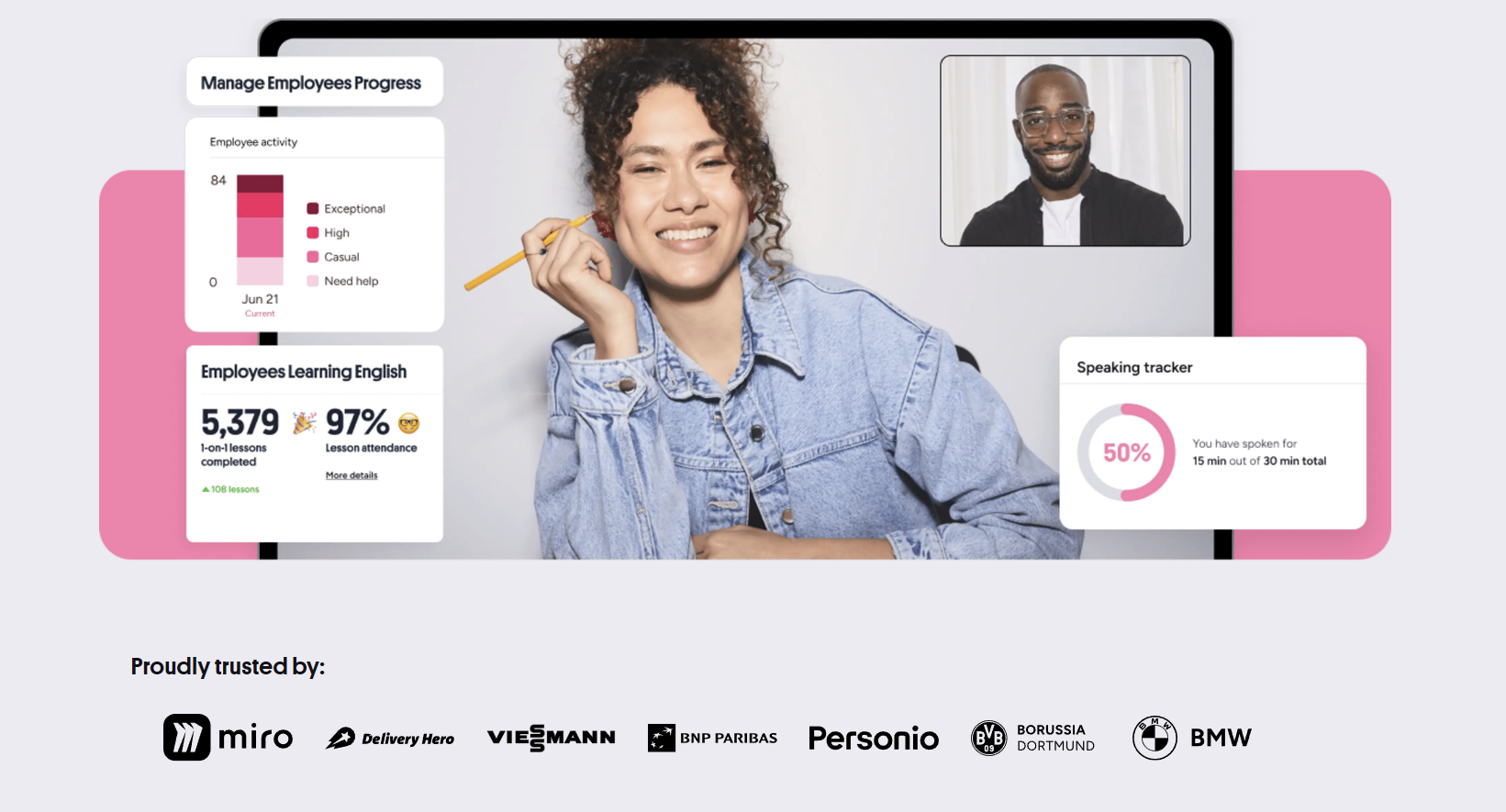
Companies that invest in language training for employees often struggle to find a solution that balances flexibility, measurable progress, and cost control. Preply employee language training has emerged as a leading option for organizations that want one-on-one tutoring at scale without the administrative burden of traditional language schools. This guide breaks down how the platform works for teams, what it costs, and whether it delivers the results businesses actually need.
Contents
- 1. What Is Preply for Business
- 2. How Preply Employee Language Training Works
- 3. Core Features for Corporate Accounts
- 4. Tutor Quality and Selection Process
- 5. Languages and Specializations Available
- 6. Setting Up a Team Account
- 7. Tracking Progress and Measuring ROI
- 8. Pricing Structure and Cost Factors
- 9. Preply vs Other Corporate Language Solutions
- 10. Real-World Rollout Patterns
- 11. Common Challenges and Mitigations
- 12. Security, Compliance, and Data Handling
- 13. Final Assessment of Preply Employee Language Training
The corporate language training market is crowded with platforms that promise fluency but deliver generic group classes or rigid curricula. Preply takes a different approach by connecting each employee with a private tutor who adapts lessons to their role, industry, and schedule. For HR and learning leaders evaluating options, the key questions center on setup time, reporting capabilities, tutor quality, and whether the investment translates to real communication improvements.
We'll cover the platform's core features, pricing structure, admin tools, and how it compares to alternatives like Babbel for Business, Berlitz, or custom in-house programs. You'll also see real feedback from companies that have rolled out Preply for teams of 10 to 500+ learners.
What Is Preply for Business
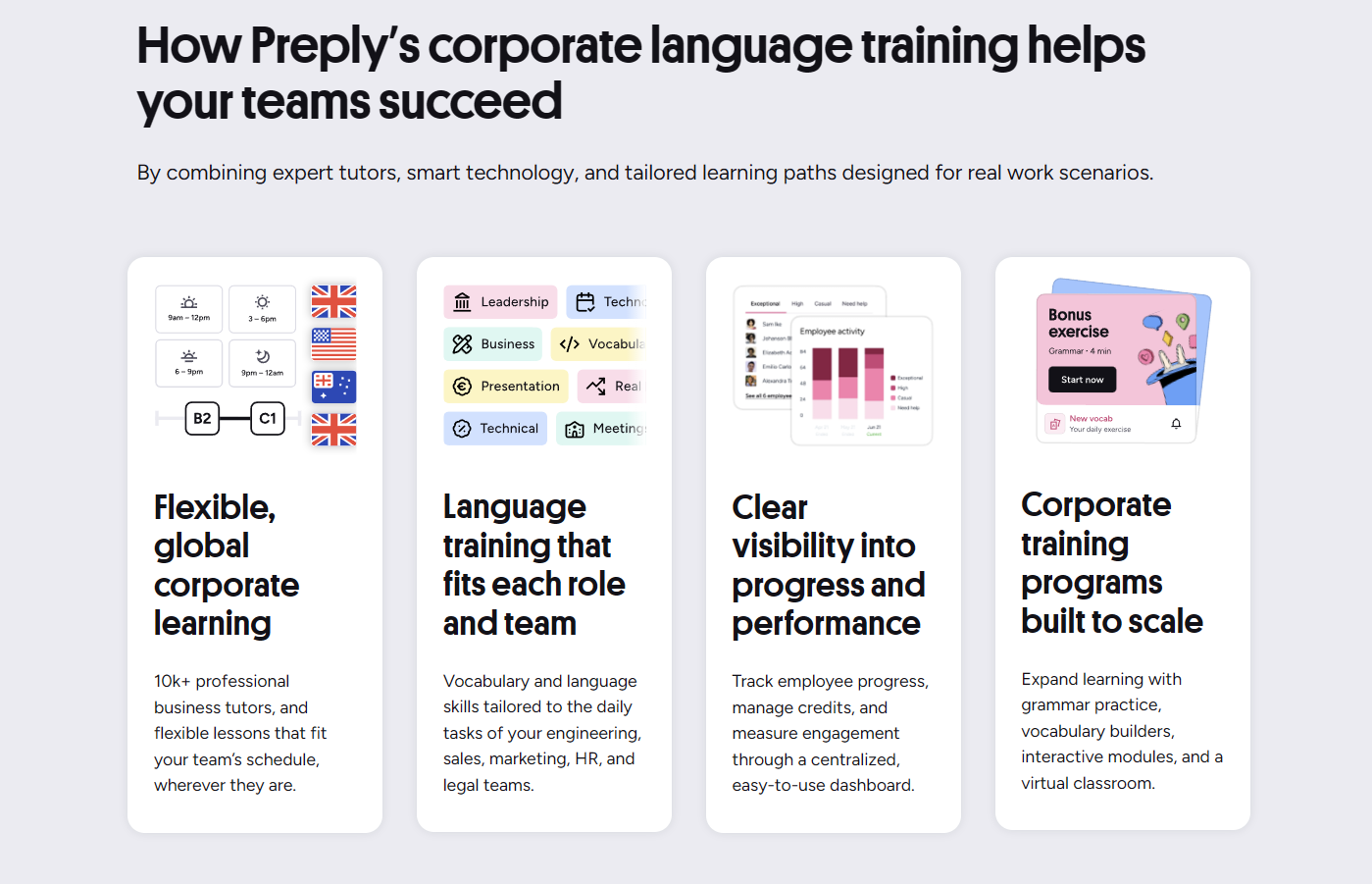
Preply for Business is the company's B2B offering built on top of its consumer marketplace. Instead of individual learners browsing tutors and booking single lessons, organizations get a centralized dashboard to manage seats, budgets, and learning paths across the workforce. The underlying tutor pool stays the same — over 32,000 tutors teaching 50+ languages — but the administrative layer adds team onboarding, progress tracking, and consolidated billing.
The product targets two main segments: small-to-mid teams (10–100 seats) that need a self-serve setup, and enterprise accounts (100+ seats) that get dedicated customer success managers, custom reporting, and API integrations with HRIS systems like Workday or BambooHR. Both tiers share the same tutor marketplace and lesson format: 50-minute one-on-one video sessions scheduled at the learner's convenience.
How Preply Employee Language Training Works
The workflow from purchase to first lesson typically takes 3–5 business days for teams under 50 seats. Enterprise rollouts add 1–2 weeks for SSO configuration, custom onboarding webinars, and integration testing. Here's the standard sequence:
- Admin purchases seat licenses (monthly or annual) and invites employees via email or CSV upload.
- Each learner takes a 20-minute adaptive placement test covering grammar, vocabulary, listening, and speaking.
- The platform recommends tutors matched to the learner's level, target language, industry, and availability.
- Learner books a trial lesson with up to three tutors before committing to a regular schedule.
- Recurring weekly slots are reserved; changes require 4-hour notice to avoid charges.
- Admin dashboard updates in real time with attendance, lesson counts, and CEFR progress estimates.
Lessons happen in Preply's built-in video classroom with screen sharing, collaborative whiteboard, chat, and automatic recording (opt-in). Tutors can assign homework from the platform's exercise library or upload custom materials. After each session, both parties rate the experience; ratings below 4 stars trigger a support review.
The platform supports blended learning paths. For example, a sales team preparing for a Latin American product launch might combine weekly Spanish conversation lessons with specialized business Spanish modules from the content library. Admins can assign the same tutor to multiple team members for consistency or let each learner choose independently.
Core Features for Corporate Accounts
Beyond the basic tutoring marketplace, Preply for Business includes several features designed for organizational use. Not all are available on the self-serve tier; some require enterprise contracts.
Scroll horizontally to see all columns
| Feature | Team (10–99 seats) | Enterprise (100+ seats) |
|---|---|---|
| Centralized billing & seat management | Yes | Yes |
| Admin dashboard with usage analytics | Yes | Yes |
| Custom placement test branding | No | Yes |
| SSO / SAML integration | No | Yes |
| HRIS sync (Workday, BambooHR, etc.) | No | Yes |
| Dedicated customer success manager | No | Yes |
| Custom reporting API | No | Yes |
| Group onboarding webinars | Self-serve only | Live facilitated |
| Priority tutor matching | Standard | Expedited |
The admin dashboard is the control center. It shows seat utilization, average lessons per learner per month, upcoming schedule density, and aggregate CEFR progress. Filters let you slice by department, location, language, or tenure. Export options include CSV and scheduled email reports. Enterprise customers can build custom dashboards via the reporting API.
The dashboard tells you who's showing up, but not whether they're actually improving. You still need to talk to managers and learners to gauge real impact.
Tutor Quality and Selection Process
Preply's tutor vetting has three stages: identity verification, profile review, and a demo lesson evaluated by the platform's quality team. Tutors set their own hourly rates ($10–$80+), and the platform takes a commission that decreases with volume (33% for first 20 hours, down to 18% after 400 hours). This model attracts both career teachers and subject-matter experts who tutor part-time.
For business accounts, the matching algorithm weights tutors with business-teaching experience, industry-specific vocabulary knowledge, and availability during standard working hours in the learner's time zone. Enterprise customers can request tutors with certifications like CELTA, DELTA, or industry credentials (e.g., medical English, legal Spanish, technical German).
Learner feedback on tutor quality is mixed. In a 2023 survey of 1,200 Preply business users, 78% rated their tutor 4+ stars, but 22% reported switching tutors at least once due to teaching style mismatch, technical issues, or scheduling conflicts. The platform's rating system (1–5 stars plus written reviews) helps, but reviews are not verified for corporate accounts — anyone who took a lesson can leave one.
Languages and Specializations Available
The platform covers 50+ languages, but depth varies. English, Spanish, French, German, Portuguese, Italian, Chinese, Japanese, and Korean have hundreds of tutors each with business-teaching tags. Less common languages (Dutch, Swedish, Polish, Arabic, Hebrew) may have 20–50 tutors, and niche languages (Finnish, Thai, Vietnamese) often have fewer than 10 with business experience.
- Business English: 4,200+ tutors with tags like presentations, negotiations, email writing, interviews
- Spanish for business: 1,100+ tutors, strong in Latin American and European variants
- German for professionals: 800+ tutors, many with DACH market experience
- French for business: 900+ tutors, including Canadian and African French specialists
- Portuguese (Brazil/Europe): 600+ tutors, growing demand for tech and agribusiness vocab
- Mandarin Chinese: 500+ tutors, HSK-aligned curricula available
- Japanese: 400+ tutors, JLPT prep and keigo (honorifics) focus
Specialized tracks exist for industries: tech (English for developers, German for IT), finance (English for banking, Mandarin for fintech), healthcare (medical English, Spanish for nurses), legal (contract English, French for law), and hospitality (English for tourism, multilingual service). These are not separate courses — they're tutor tags and supplemental material collections. Quality depends on the individual tutor's actual experience.
Setting Up a Team Account
Self-serve setup for teams under 100 seats takes about 30 minutes for the admin. The flow: choose monthly or annual billing, enter seat count, add payment method, upload learner list (name, email, target language, optional department), and send invitations. Learners receive a branded email with a magic link — no password creation required. They land on a personalized dashboard with their placement test front and center.
Enterprise onboarding adds a kickoff call with a customer success manager, SSO configuration (SAML 2.0, OIDC), HRIS field mapping for automatic seat provisioning/deprovisioning, and a custom learner portal with company logo and welcome video. The manager also helps design a rollout plan: pilot group selection, success metrics, communication templates, and manager enablement materials.
Seat management is flexible. Unused seats can be reassigned instantly. If an employee leaves, the admin revokes access and the seat returns to the pool. Monthly plans allow seat count changes at renewal; annual plans lock the count but offer 15–20% discount. Enterprise contracts often include a 10% overage buffer for mid-year hiring.
Tracking Progress and Measuring ROI
Preply provides three layers of progress data: attendance (lessons completed vs. scheduled), CEFR level estimates (updated after each placement test retake, recommended quarterly), and tutor-reported skill assessments (speaking, listening, reading, writing) submitted monthly. The admin dashboard aggregates these into team-level trends.
What's missing: standardized test scores (TOEIC, IELTS, DELE) unless the tutor explicitly prepares the learner for them, and business-outcome metrics (deal closure rate, support ticket resolution time, presentation confidence). Preply does not connect to performance management systems. Companies that need hard ROI numbers typically run their own pre/post assessments or correlate Preply usage with internal KPIs.
Scroll horizontally to see all columns
| Metric | Frequency | Granularity |
|---|---|---|
| Lessons completed | Real-time | Per learner, per team, org-wide |
| Attendance rate | Weekly | Per learner, per team |
| CEFR level estimate | Quarterly (on retest) | Per learner |
| Tutor skill ratings | Monthly | Per learner (4 skills) |
| Homework completion | Per lesson | Per learner |
| Seat utilization | Daily | Org-wide, per department |
We saw a 0.5 CEFR level jump in 6 months for the pilot group. But the real win was engineers feeling confident enough to lead stand-ups in English — that doesn't show in the dashboard.
Pricing Structure and Cost Factors
Preply for Business does not publish fixed price lists. Pricing depends on seat count, commitment length, tutor rate tier, and enterprise add-ons. The platform charges per seat per month, and each seat includes a lesson allowance (typically 4 lessons/month for standard plans). Unused lessons do not roll over. Overage lessons are billed at the tutor's hourly rate plus platform fee.
- Team monthly: ~$35–$55/seat/month for 4 lessons with mid-range tutors ($15–$25/hr)
- Team annual: ~$30–$48/seat/month (15% discount), same lesson allowance
- Enterprise: custom quotes, typically $40–$70/seat/month including dedicated support, SSO, API, and priority matching
- Tutor rate tiers: Budget ($10–$15), Standard ($15–$30), Premium ($30–$50), Expert ($50+)
- Add-ons: Custom content development ($2,000–$10,000), live group workshops ($500/session), assessment center ($15/learner)
A 50-seat team on annual standard plan with 4 lessons/month at $20/hr tutors: 50 seats × $38/seat × 12 months = $22,800/year base. If average tutor rate is $22 and learners use 3.5 lessons/month on average, overage is minimal. Budget $25,000–$28,000 total. Enterprise with 200 seats, premium tutors ($40/hr), SSO, and API: expect $120,000–$160,000/year.
Preply vs Other Corporate Language Solutions
The main alternatives fall into three categories: self-paced apps (Babbel for Business, Busuu, Rosetta Stone), live group classes (Berlitz, EF Corporate, Learnlight), and tutor marketplaces (italki Business, Verbling for Teams). Each serves a different learning model and budget.
Scroll horizontally to see all columns
| Provider | Format | Typical cost/seat/mo | Best for |
|---|---|---|---|
| Preply for Business | 1-on-1 live tutoring | $35–$70 | Personalized, flexible, role-specific |
| Babbel for Business | Self-paced app + optional live | $8–$15 | Large scale, low budget, baseline proficiency |
| Berlitz Corporate | Live group + 1-on-1 | $60–$120 | Intensive, structured, certification prep |
| EF Corporate Learning | Blended (app + group + 1-on-1) | $50–$100 | Global enterprises, integrated LMS |
| italki Business | 1-on-1 live tutoring | $30–$60 | Budget-conscious, tutor choice priority |
| Learnlight | Blended with proprietary platform | $70–$130 | Data-driven, custom curriculum, compliance |
Preply's advantage is tutor choice and schedule flexibility. Learners aren't locked into a fixed class time or curriculum. The downside is inconsistency — no guaranteed pedagogy, no standardized outcomes. Babbel scales cheaply but lacks speaking practice. Berlitz and EF deliver consistency at 2–3x the cost. italki Business is similar to Preply but with a smaller tutor pool and fewer enterprise features. Learnlight targets regulated industries needing audit trails.
We evaluated Preply against Babbel and Berlitz. Preply won for our sales team because they needed negotiation practice, not grammar drills. For the factory floor, we kept Babbel — cheaper and good enough for safety vocabulary.
Real-World Rollout Patterns
Companies tend to follow one of three deployment models. The choice shapes budget, admin effort, and outcomes.
- Targeted upskilling: 10–50 seats for specific roles (sales, support, engineering) with clear language gaps. High engagement, measurable business case. Typical duration: 6–12 months.
- Broad benefit: 100–500+ seats offered as a perk (like gym membership). Low mandatory usage, high variance in participation. Often paired with wellness stipends. Retention driver more than skill builder.
- Strategic transformation: 50–200 seats tied to market expansion, M&A integration, or digital transformation. Mandatory minimums, manager accountability, custom success metrics. Highest admin investment, highest potential ROI.
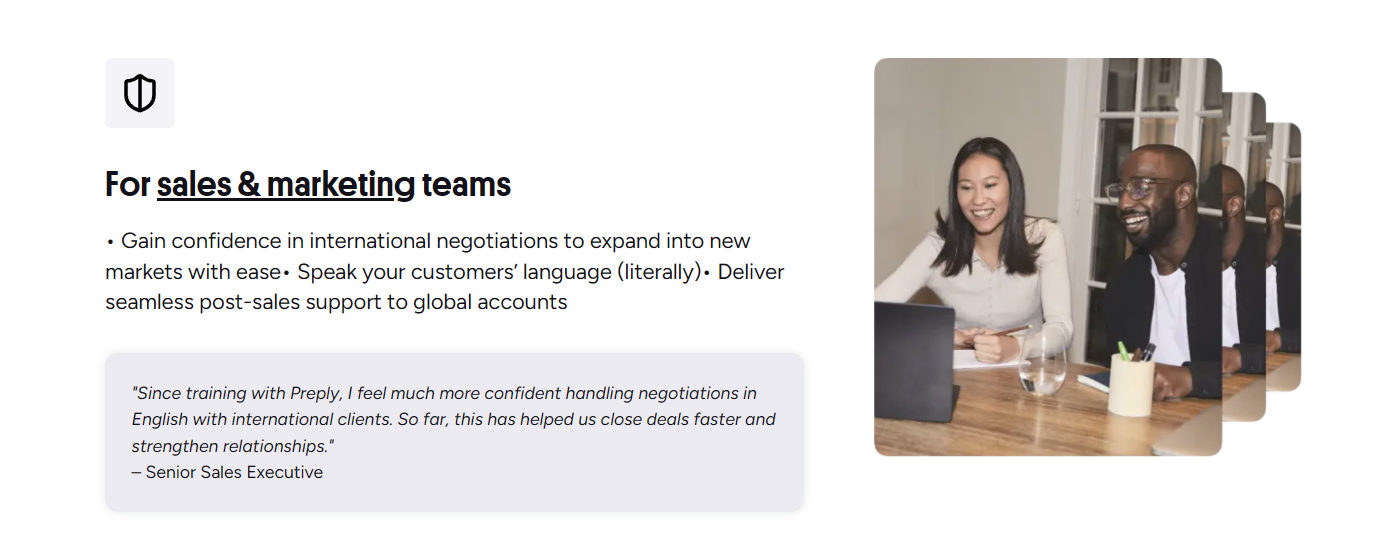
A mid-sized SaaS company (180 employees) used the targeted model for 25 customer-facing staff learning Spanish and Portuguese for LATAM expansion. They set a 2-lesson/week minimum, tied completion to quarterly bonuses, and tracked demo-to-close rates by language. After 9 months, Spanish-speaking reps closed 23% more deals in Mexico and Colombia. The program cost $42,000; attributed revenue lift was ~$1.2M.
A global manufacturer (12,000 employees) ran the broad benefit model with 800 seats across 14 countries. Participation averaged 1.2 lessons/week per active learner, but only 45% of seat holders were active monthly. HR treated it as a retention perk — exit surveys cited language learning as a top-5 benefit. Cost: $380,000/year. Hard ROI unmeasured, but employer brand surveys improved.
A fintech startup (300 employees) chose strategic transformation for 60 engineers and product managers learning English for global collaboration. They mandated 3 lessons/week, assigned the same tutor to each scrum team, and integrated Preply data into their OKR dashboard. Six months in, cross-team communication incidents dropped 37% (measured by Jira ticket rework rate). Program cost: $110,000. The CTO called it 'the highest-leverage L&D spend we've made.'
Common Challenges and Mitigations
No platform is frictionless. The most frequent complaints from Preply business admins and learners cluster in five areas.
- Scheduling volatility: Tutors change availability, learners reschedule, time zones drift. Mitigation: set recurring slots, enable 4-hour change policy, use enterprise priority matching for faster replacements.
- Progress plateau: Learners hit intermediate ceiling (B1–B2) and stop advancing. Mitigation: rotate tutors every 20–30 hours for fresh perspective, add specialized modules (presentations, writing), supplement with group workshops.
- Admin overhead: Self-serve teams spend 2–4 hours/week managing seats, chasing attendance, exporting reports. Mitigation: automate CSV exports, delegate to department leads, upgrade to enterprise for CSM support.
- Tutor turnover: High-performing tutors leave for higher-paying private clients. Mitigation: request backup tutors, build relationships with 2–3 tutors per language, consider rate matching for critical tutors.
- Data gaps: Dashboard shows activity, not proficiency. Mitigation: run quarterly external assessments (Versant, Linguaskill), correlate with internal performance data, use tutor skill ratings as leading indicator.
Security, Compliance, and Data Handling
Preply is GDPR compliant and offers a Data Processing Addendum (DPA) for enterprise customers. Data centers are in AWS Frankfurt (EU) and AWS Virginia (US). Lesson recordings are encrypted at rest and in transit; access requires learner consent. The platform is not SOC 2 Type II certified as of 2024 — a gap for regulated industries (finance, healthcare, government). Enterprise contracts can include custom data retention policies (default: 2 years for recordings, 5 years for progress data).
Single sign-on supports SAML 2.0 and OpenID Connect. Provisioning via SCIM 2.0 is on the roadmap (beta as of Q2 2024). Admin audit logs capture seat changes, tutor assignments, and data exports. No on-premise deployment option. Companies with strict data residency requirements should verify the EU hosting option meets their needs before committing.
Final Assessment of Preply Employee Language Training
Preply employee language training works best when the organization has clear, role-specific language needs, values flexibility over standardization, and can tolerate some tutor variability. It shines for targeted upskilling — sales teams entering new markets, engineers collaborating across borders, support agents handling multilingual tickets. The one-on-one format accelerates speaking confidence faster than apps or group classes, and the admin tools are sufficient for teams up to a few hundred seats.
It falls short for compliance-driven training where every learner must reach a certified level on a fixed timeline, for organizations that need guaranteed pedagogy across hundreds of tutors, or for budgets that can't absorb tutor rate fluctuations. The lack of SOC 2 and limited outcome metrics also make it a harder sell to procurement and legal in regulated sectors.
If you're evaluating Preply for Business, run a paid pilot with 10–15 motivated learners for 4–6 weeks. Track both platform metrics (attendance, CEFR movement) and business proxies (meeting participation, email quality, customer feedback). Involve managers from day one. Compare the cost per measurable improvement against Babbel (lower cost, lower intensity) and Berlitz/EF (higher cost, higher structure). The right choice depends on whether your priority is scale, standardization, or personalized acceleration.
Frequently Asked Questions
How many lessons per month are included in a Preply business seat?
Standard plans include 4 lessons per month per seat. Unused lessons do not roll over. Enterprise contracts can customize the allowance.
Can we require employees to use specific tutors or curricula?
Admins can recommend tutors and assign supplemental materials, but cannot mandate tutor selection or enforce a standardized curriculum. Learners choose from matched tutors.
What happens if a tutor leaves the platform mid-program?
Preply automatically rematches affected learners. Enterprise accounts get rematching within 48 hours with priority matching. Team plans typically take 3–5 business days.
Does Preply provide official language certificates?
No. Preply provides CEFR level estimates based on placement tests and tutor assessments. For official certificates (TOEIC, IELTS, DELE, etc.), learners must register for external exams separately.
Can we integrate Preply with our HRIS or LMS?
Enterprise plans support SSO (SAML/OIDC) and HRIS sync via API (Workday, BambooHR, others). SCIM provisioning is in beta. Team plans do not have integration access.
What is the minimum contract length?
Team plans offer monthly or annual billing. Enterprise contracts are typically 12 months with volume discounts. Pilot programs can be shorter by arrangement.
How does Preply handle tutor rate increases?
Tutors can increase rates with 30 days' notice. The new rate applies to future lessons. Enterprise contracts can negotiate rate caps or fixed-rate periods.