

Business Education
Preply For Business: Corporate Language Training Platform
How companies use Preply for employee language development and global communication
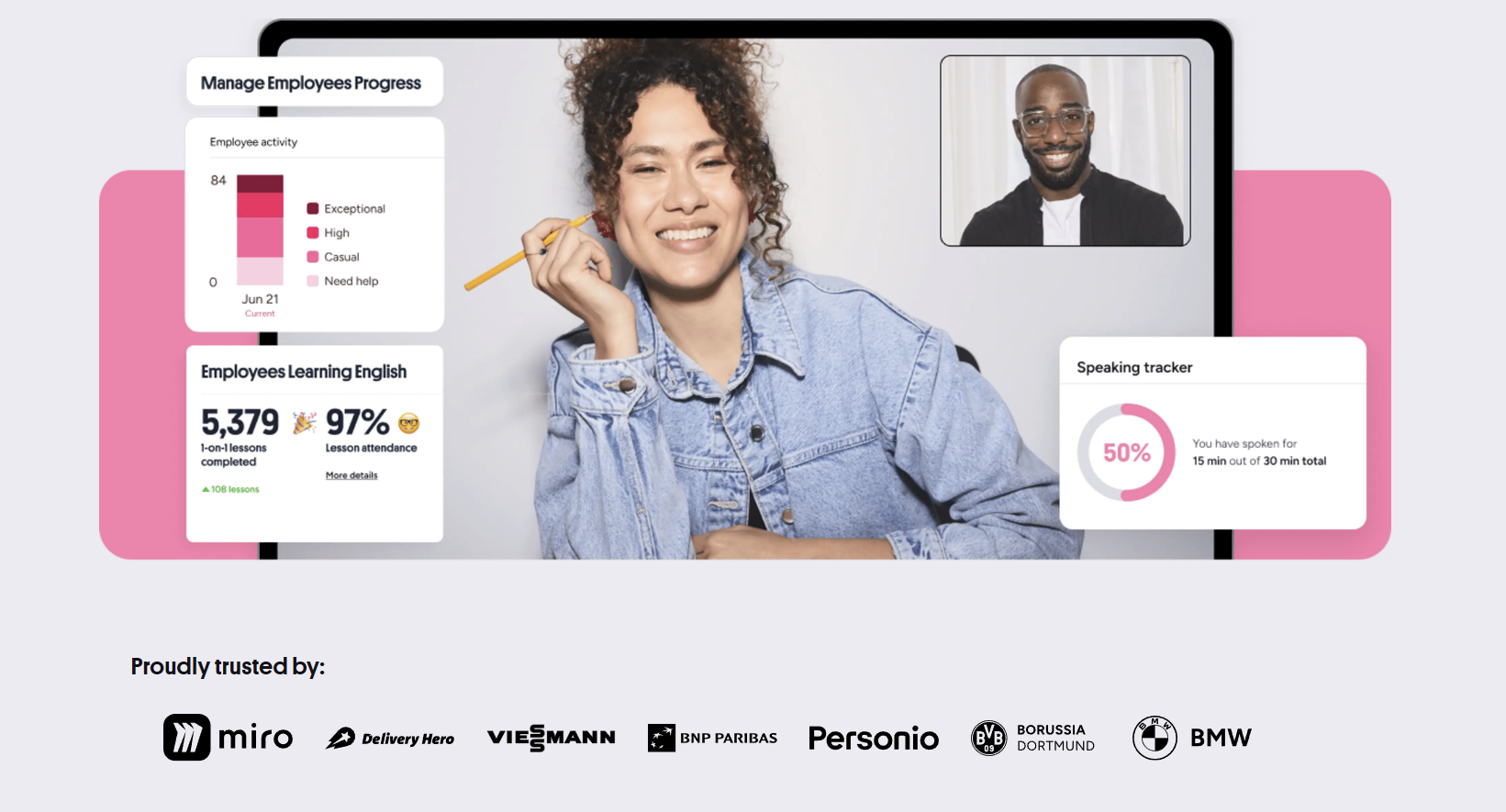
Companies expanding across borders face a consistent challenge: language barriers slow down collaboration, complicate client relationships, and limit talent mobility. Preply For Business addresses this by offering a marketplace model where organizations connect employees with tutors for one-on-one lessons tailored to professional goals. Unlike traditional corporate language programs that rely on rigid curricula or group classes, this approach lets each learner focus on the specific vocabulary, scenarios, and communication skills their role demands.
Contents
- 1. What Preply For Business Offers Companies
- 2. Setting Up Team Accounts and Administration
- 3. Tutor Selection for Professional Contexts
- 4. Scheduling Flexibility Across Time Zones
- 5. Progress Tracking and Reporting Features
- 6. Pricing Structure for Organizations
- 7. Integration with Existing Learning Systems
- 8. Security and Data Privacy Considerations
- 9. Customer Success Stories and Use Cases
- 10. Comparing Preply Business to Alternatives
- 11. Implementation Best Practices
- 12. Managing Tutor Relationships at Scale
- 13. Final Assessment of Preply For Business
The platform serves startups with a handful of international hires and enterprises managing thousands of learners across dozens of countries. What distinguishes it from consumer-focused language apps is the administrative layer — dashboards for procurement, usage analytics, centralized billing, and compliance features that procurement and L&D teams actually need. This article examines how the product works in practice, where it fits in a corporate learning stack, and what decision-makers should evaluate before committing budget.
What Preply For Business Offers Companies
At its core, the business product wraps the same tutor marketplace that individual learners use with organizational controls. Employees get access to tutors across 50+ languages, with filters for specialization — business English, technical German, legal Spanish, medical Japanese, and so on. Lessons happen over video with a built-in classroom that includes screen sharing, collaborative documents, and session recording. The company pays for packages of hours or subscriptions, and administrators allocate those hours to learners or teams.
A key difference from the consumer side: tutors who opt into the business program complete additional verification and often have experience teaching professionals. Many hold certifications in business English instruction or have corporate backgrounds themselves. The platform surfaces this information in tutor profiles so managers can match learners with relevant expertise. For instance, a sales team preparing for Latin American expansion can filter for tutors with experience in negotiation vocabulary and regional business culture.
- Individual 50-minute lessons with vetted tutors
- Group sessions for up to six participants
- Custom learning plans aligned to role requirements
- Progress dashboards for managers and learners
- Centralized billing with invoice-based payment terms
- SSO integration and SCIM provisioning on enterprise plans
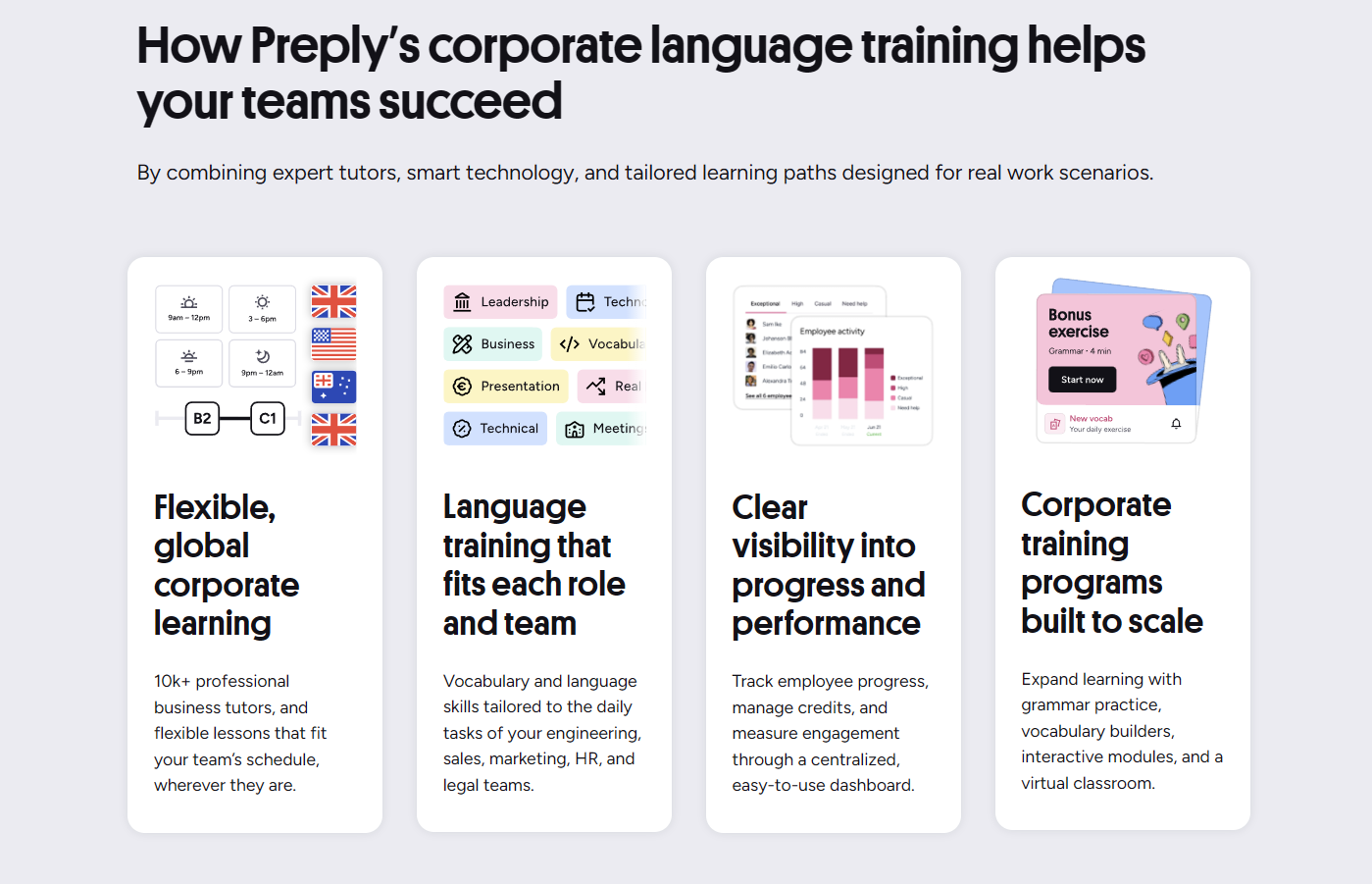
The group session option deserves attention. While one-on-one remains the primary format, some companies use small cohorts for onboarding cohorts, leadership cohorts, or project-based language prep. The platform handles scheduling across time zones automatically — a practical necessity when your team spans São Paulo, Warsaw, and Singapore.
The dashboard gives administrators visibility into utilization rates, upcoming lessons, completion metrics, and spending against budget. Learners see their own progress tracker, lesson history, and tutor feedback. This dual view matters — L&D leaders need aggregate data for reporting, while employees need a clear personal experience that doesn't feel like surveillance.
Setting Up Team Accounts and Administration
Onboarding starts with a demo call where a solutions engineer walks through the admin console. Most companies pilot with 10–50 learners before scaling. The admin panel supports role-based access: account owners control billing and contracts, program managers assign learners and monitor progress, and team leads view their direct reports' activity. This granularity prevents the common problem where HR has full visibility but department heads can't see their own team's data.
Learner invitation happens via email or bulk CSV upload. Each invitee creates a Preply account linked to the organization, selects their target language, takes a placement assessment, and receives tutor recommendations. The assessment is adaptive — it adjusts difficulty based on responses and takes roughly 15 minutes. Results map to CEFR levels and inform the initial learning plan. Tutors see this baseline before the first lesson, which saves the usual diagnostic session.
Budget controls are flexible. Admins can set monthly hour caps per learner, per team, or globally. Unused hours roll over within the billing period depending on the contract. Some companies allocate a fixed annual stipend per employee; others fund specific initiatives like "English for Engineering" or "Spanish for Sales." The platform supports both models without requiring separate accounts.
Tutor Selection for Professional Contexts
The tutor pool is the product's strongest asset and its biggest variable. Preply hosts over 30,000 tutors, but only a subset participates in the business program. Those who do complete identity verification, background checks, and a teaching demo evaluated by Preply's team. Profiles display years of experience, specializations, student ratings, and — critically — whether they've taught corporate clients before.
For business learners, tutor fit matters more than for casual students. A software engineer preparing for technical interviews in English needs someone who understands system design terminology, not just conversational fluency. A legal team reviewing contracts in French needs a tutor familiar with civil law vocabulary. The platform's filters handle this reasonably well: you can search by specialization tags, industry experience, and availability windows that match your team's working hours.
Scroll horizontally to see all columns
| Filter Category | Examples |
|---|---|
| Language Specialization | Business English, Legal Spanish, Technical German |
| Industry Background | Finance, Healthcare, Technology, Manufacturing |
| Certification | CELTA, DELTA, TESOL, Industry-specific credentials |
| Availability | Time zone, Morning/Evening, Weekend options |
| Teaching Focus | Presentations, Negotiations, Writing, Exam Prep |
One practical limitation: the best tutors for niche professional contexts often have limited availability. A tutor who specializes in pharmaceutical regulatory German and works European business hours may have only two evening slots per week. Companies with urgent needs sometimes find themselves compromising on specialization or waiting for openings. Planning lead time of 2–3 weeks for specialized matches is realistic.
The marketplace model means tutor quality varies. Preply's verification raises the floor, but the ceiling depends on individual tutor expertise — same as any professional services platform.
Scheduling Flexibility Across Time Zones
Global teams live and die by scheduling. Preply's calendar shows tutor availability in the learner's local time zone, handles daylight saving transitions, and sends automated reminders. Learners book, reschedule, or cancel up to 4 hours before a session without penalty. For administrators, the system enforces policy — you can set maximum lessons per week, block booking windows, or require manager approval for sessions outside standard hours.
The 4-hour cancellation window is stricter than some competitors (italki allows 24 hours; some corporate providers allow same-day changes). This protects tutor income but can frustrate employees dealing with unpredictable meetings. Some companies build a small buffer of "flex hours" into their budget to absorb last-minute changes without penalizing learners.
- Automatic time zone conversion for global teams
- Recurring weekly slots with the same tutor
- Bulk scheduling for cohort programs
- Calendar sync with Google Calendar and Outlook
- Mobile app notifications for upcoming lessons
Recurring slots are the default for serious programs. Consistency with the same tutor accelerates progress — the tutor learns the learner's gaps, industry context, and communication style. The platform encourages this by letting learners lock in a weekly time. When a tutor becomes unavailable (vacation, schedule change), the system suggests alternatives with similar profiles, though the handoff still requires a ramp-up period.
The mobile app mirrors desktop scheduling functionality. Employees traveling or working remotely can manage lessons from their phone, though the full classroom experience — screen sharing, collaborative docs — works best on desktop. Most business learners use the app for booking and reminders, then join lessons from a laptop.
Progress Tracking and Reporting Features
Progress measurement in language learning is notoriously difficult. Preply approaches it through three lenses: tutor assessments, learner self-evaluation, and platform analytics. After every lesson, tutors rate the learner on speaking, listening, vocabulary, and grammar using a 5-point scale. These micro-assessments aggregate into trend lines. Learners also complete quarterly self-assessments mapped to CEFR can-do statements. The admin dashboard shows both data streams side by side.
For L&D reporting, the platform exports CSV files with utilization rates, hours consumed, average tutor rating, assessment trends, and completion rates by team. Enterprise plans include API access for feeding data into an LMS or HRIS. The reports are functional but not beautiful — expect to build your own visualizations if leadership expects polished dashboards.
Some companies supplement with external assessments — Versant, Linguaskill, or TOEIC — administered quarterly. Preply doesn't include these, but tutors can prep learners for them. The platform's own level test is useful for placement and rough progress tracking, but it's not a certified credential. If your compliance or vendor requirements demand certified proof, budget for third-party testing separately.
Pricing Structure for Organizations
Preply For Business uses tiered pricing based on volume and contract length. There's no public price list — quotes come after a demo call. Broadly, three tiers exist: Team (10–50 learners), Business (50–500), and Enterprise (500+). All tiers include admin dashboard, progress tracking, and centralized billing. Enterprise adds SSO, SCIM, dedicated customer success manager, custom SLA, and API access.
Pricing is per hour of instruction, with volume discounts at higher tiers. A typical Team-tier rate falls around $25–35 per hour depending on language and tutor seniority. Business tier drops to $20–30. Enterprise is negotiated case by case. Some companies compare this to traditional language schools charging $40–60 per hour for group classes — but the comparison is imperfect. One-on-one tutoring delivers more speaking time per dollar, yet lacks the peer interaction and structured curriculum of cohort-based programs.
Scroll horizontally to see all columns
| Tier | Learner Range | Rate Range | Key Features |
|---|---|---|---|
| Team | 10–50 | $25–35 | Admin dashboard, reporting, invoice billing |
| Business | 50–500 | $20–30 | Volume discount, priority support, custom goals |
| Enterprise | 500+ | Custom | SSO, SCIM, API, dedicated CSM, SLA |
Contracts are typically annual with monthly or quarterly billing. Mid-contract learner count adjustments are allowed — you can add seats anytime, remove at renewal. Unused hours generally don't roll over year to year, though some enterprise contracts negotiate carryover. There's no free trial for the business product, but Preply often offers a paid pilot (e.g., 50 hours for 5 learners over 30 days) at a discounted rate to validate fit.
Integration with Existing Learning Systems
Integration depth depends on your tier. Team and Business plans support SCIM provisioning via Okta, Azure AD, or Google Workspace — this automates user creation, deactivation on offboarding, and group membership sync. Enterprise adds REST API access for custom workflows: pulling lesson data into an LMS, triggering nudges in Slack or Teams, or feeding completion records into an HRIS for compliance tracking.
The platform doesn't have native LMS integrations (no Cornerstone, Workday Learning, or Docebo connectors out of the box). If your learning ecosystem requires Preply activity to appear in a central transcript, you'll build that via API or use a middleware layer like Zapier. Some companies accept this — they treat Preply as a standalone benefit with its own reporting — but others find the disconnected data frustrating.
- SCIM provisioning for automated user lifecycle
- SAML 2.0 SSO for seamless login
- REST API for custom reporting and workflows
- Webhook events for lesson completion, booking, cancellation
- CSV export for ad-hoc analysis
Single sign-on works reliably. Employees click "Login with SSO" and land in their Preply dashboard without managing separate credentials. This matters for adoption — every additional password reduces participation. The SSO implementation supports just-in-time provisioning: a user's first SSO login creates their account and applies the correct team assignment based on directory attributes.
Security and Data Privacy Considerations
Preply is GDPR compliant and offers a Data Processing Addendum for EU customers. Data centers are in the US and EU; enterprise customers can request EU-only hosting. Lesson recordings, chat logs, and shared documents are encrypted at rest and in transit. Tutors sign NDAs as part of onboarding, though the platform doesn't enforce content restrictions on what learners discuss — if an employee shares confidential product details during a lesson, that data exists in the recording and chat history.
Administrators can disable recording organization-wide or per learner. They can also restrict file uploads in the classroom. For highly regulated industries (finance, healthcare, defense), these controls may be insufficient. Some companies prohibit Preply for sensitive roles and route those learners to in-house trainers or vetted vendors with stricter data handling. Preply does not currently hold SOC 2 Type II or ISO 27001 certification — a gap for enterprise procurement checklists.
Customer Success Stories and Use Cases
Public case studies highlight a few patterns. A European fintech scaled from 20 to 300 learners in 18 months, using Preply for English, German, and Polish across product, sales, and support teams. They reported 85% utilization and measurable improvement in customer-facing communication scores. A Japanese manufacturer used the platform for "English for Engineers" — 120 technical staff preparing for international project collaboration. Their key insight: pairing engineers with tutors who had STEM backgrounds cut ramp-up time by roughly 40% compared to generalist tutors.
A Latin American logistics company took a different approach: they bought group sessions for warehouse supervisors learning English for safety protocols. The cohort model built peer accountability — supervisors practiced together between lessons. Completion rates exceeded 90%, which the L&D lead attributed to social pressure and shared relevance. This suggests group formats work well when the learning objective is uniform across a role.

Not every story is a win. Some pilots stall because managers don't protect learning time — employees skip lessons when deadlines hit. Others struggle with tutor consistency when popular tutors raise rates or leave the platform. A recurring theme in feedback: success correlates with executive sponsorship and protected calendar time, not platform features alone.
Comparing Preply Business to Alternatives
The competitive landscape splits into three categories. Traditional language schools (Berlitz, EF, local providers) offer structured curricula, certified teachers, and cohort classes — but at higher cost, less scheduling flexibility, and limited tutor choice. Digital platforms like Babbel for Business or Busuu provide self-paced courses with live tutoring add-ons — scalable and cheap, but less personalized and no tutor relationship. Freelance marketplaces (italki, Verbling) give tutor choice and low cost — but lack admin controls, reporting, and compliance features.
Scroll horizontally to see all columns
| Provider Type | Cost per Hour | Flexibility | Admin Controls | Best For |
|---|---|---|---|---|
| Preply For Business | $20–35 | High | Strong | Personalized 1:1 at scale |
| Traditional Schools | $40–80 | Low | Moderate | Certified programs, cohorts |
| Self-Paced + Live | $10–20 | Medium | Basic | Large populations, budget constraints |
| Freelance Marketplaces | $10–30 | High | Minimal | Small teams, informal learning |
Preply sits in a pragmatic middle: more structure than a raw marketplace, more flexibility than a school. The trade-off is operational overhead. Managing 200 individual tutor relationships — even through a dashboard — requires more coordination than assigning 200 licenses to a self-paced course. Companies that treat it as "set and forget" see low utilization. Those that assign program managers, set participation expectations, and review monthly data get results.
Implementation Best Practices
Patterns from successful rollouts are consistent. First, define the business problem: "Sales needs negotiation English for Q3 product launch" beats "We should offer language learning." Second, secure calendar protection — block recurring 60-minute windows on learners' calendars and communicate that these are as immovable as client meetings. Third, assign a program owner who reviews utilization weekly and follows up with learners below 50% attendance.
- Tie language goals to specific business outcomes
- Block recurring calendar slots before launch
- Assign a program owner with weekly review cadence
- Run a 30-day paid pilot with 10–20 motivated learners
- Collect qualitative feedback at 2, 6, and 12 weeks
- Negotiate tutor continuity clauses for critical roles
The pilot phase is where most programs live or die. Run it with volunteers who have a clear, immediate need — not a random sample. Track both quantitative metrics (hours used, lessons completed, assessment delta) and qualitative signals (learner confidence, manager observations, tutor feedback). If the pilot hits 70%+ utilization and positive sentiment, scale. If not, diagnose: wrong tutors? wrong goals? no time? The platform can't fix cultural barriers to learning.
Managing Tutor Relationships at Scale
A distinctive aspect of Preply's model: tutors are independent contractors, not employees. They set their own rates (within platform bands), manage their own schedules, and can leave the platform anytime. For a company with 50 learners each working with a different tutor, that's 50 vendor relationships mediated by Preply. The platform handles payment, contracts, and dispute resolution, but the human relationship — teaching style, reliability, rapport — sits between learner and tutor.
This creates both opportunity and risk. Opportunity: learners can switch tutors instantly if the fit isn't working, without HR involvement. Risk: a tutor who's perfect for your legal team's contract review prep might raise their rate 30% at renewal, or accept a full-time role and leave. Preply doesn't guarantee tutor retention. Some enterprise contracts include "preferred tutor" provisions — priority access to specific tutors in exchange for volume commitments — but these are negotiated individually.
For critical roles (executives, key client-facing hires), some companies bypass the marketplace entirely and hire tutors directly as contractors after meeting them on Preply. This removes platform fees but adds compliance, payment, and scheduling overhead. Preply's terms allow this after a cooling-off period, though they'd prefer you stay on platform. It's a lever worth knowing exists.
The platform's review system helps surface quality. Business learners leave reviews visible only to other business users (separate from public reviews). These tend to be more detailed — covering responsiveness, preparation, industry knowledge, and reliability. Encourage your learners to write them; they become a valuable internal reference for future matching.
Final Assessment of Preply For Business
Preply For Business solves a real problem: giving globally distributed teams access to personalized language instruction without the logistics nightmare of coordinating dozens of individual tutors. The admin layer — billing, reporting, provisioning, scheduling — is competent and covers what most mid-market and enterprise buyers need. The tutor marketplace provides depth and specialization that traditional providers can't match at this price point.
The limitations are equally real. No certified outcomes. No SOC 2. No native LMS integration. Tutor continuity isn't guaranteed. The platform measures activity, not business impact. And the model only works if your culture protects learning time — no software fixes managers who treat language lessons as optional. For organizations that accept these constraints and invest in program management, Preply delivers a flexible, cost-effective way to build language capability at scale. For those expecting a turnkey solution that runs itself, the results will disappoint.
Frequently Asked Questions
How many languages does Preply For Business support?
Over 50 languages are available, including major business languages like English, Spanish, German, French, Chinese, Japanese, Portuguese, Arabic, and many others with specialized tutors.
Can we use Preply For Business for compliance-mandated language training?
Preply provides completion tracking and progress reports, but its assessments are not certified credentials. For regulatory compliance requiring certified proof (e.g., ICAO aviation English, medical licensing), you'll need third-party testing alongside Preply lessons.
What happens if a tutor leaves the platform mid-program?
Preply suggests replacement tutors with similar profiles. The learner's lesson history and progress data transfer, but the new tutor needs ramp-up time. Enterprise contracts can negotiate preferred tutor provisions for critical roles.
Is there a minimum contract size or duration?
Typical minimum is 10 learners on an annual contract. Paid pilots (e.g., 50 hours for 5 learners over 30 days) are often available to validate fit before committing.
How does billing work for global teams in different currencies?
Billing is centralized in USD (or EUR/GBP by agreement). The organization receives a single invoice. Learners in different countries don't handle individual payments or currency conversion.
Can we restrict which tutors our employees can book?
Admins can set filters by language, specialization, and price band, but cannot whitelist specific tutors or block individual tutors globally. Learners choose from available tutors matching the criteria.
Does Preply For Business integrate with Workday or Cornerstone?
No native connectors exist. Enterprise API access allows custom integration, or middleware like Zapier can bridge basic data flows. SCIM provisioning works with Okta, Azure AD, and Google Workspace for user lifecycle management.