
Language Learning
Preply English Tutors: Find the Right Teacher for You
A practical guide to selecting an English tutor on Preply, from pricing to lesson formats.
Preply has become one of the most recognizable names in online language tutoring. The platform connects learners with thousands of English tutors worldwide, offering everything from casual conversation practice to structured exam preparation. What makes it different from a traditional language school is the flexibility: you choose the tutor, the schedule, and the focus of each lesson. That freedom is appealing, but it also means the quality of your experience depends heavily on how well you navigate the marketplace.
Contents
- 1. How Preply English Tutors Work
- 2. Finding a Tutor That Matches Your Goals
- 3. Preply English Tutor Prices and Subscription Options
- 4. Using the Preply English Level Test
- 5. Lesson Formats and Scheduling Flexibility
- 6. What Makes a Good English Tutor on Preply
- 7. Preply for Business English and Corporate Training
- 8. Tutor Requirements and Quality Controls
- 9. Comparing Preply with Other Tutoring Platforms
- 10. Managing Your Subscription and Lesson Credits
- 11. Progress Tracking and Learning Tools
- 12. Common Pitfalls and How to Avoid Them
- 13. Final Assessment of Preply English Tutors
This guide walks through the practical side of using Preply for English. It covers how the platform works, what the pricing actually looks like, how to evaluate tutor profiles, and where the common friction points are. The goal is not to sell you on the service but to give you a clear picture of what to expect so you can decide whether it fits your learning style, budget, and goals.
If you have never used a tutor marketplace before, the sheer number of options can feel overwhelming. Preply lists tutors with hourly rates ranging from roughly $5 to over $50, with filters for nationality, specialization, availability, and student ratings. The platform also provides a placement test, a mobile app, and a subscription model that locks in a weekly lesson schedule. Understanding how these pieces fit together will save you time and money.
How Preply English Tutors Work
At its core, Preply is a two-sided marketplace. Tutors create profiles describing their qualifications, teaching style, and hourly rate. Students browse, filter, and book trial lessons — usually 50 minutes — at a discounted rate or sometimes free, depending on current promotions. After the trial, you purchase a package of hours (4, 8, 12, or more) and schedule recurring or one-off sessions. Lessons happen in Preply's built-in video classroom, which includes a whiteboard, chat, file sharing, and screen sharing. The platform handles payments, reminders, and dispute resolution.
One detail that surprises new users: Preply takes a commission from every lesson. The percentage starts at 33% for a tutor's first few students and drops to 18% after they reach a certain threshold. This affects tutor earnings and, indirectly, the rates you see. Tutors often set their listed price higher to account for the cut. The platform also encourages subscriptions — committing to a weekly slot — by offering a small per-lesson discount and guaranteeing the tutor's availability. If you cancel a subscription lesson with less than 4 hours' notice, you lose that lesson credit.
Finding a Tutor That Matches Your Goals
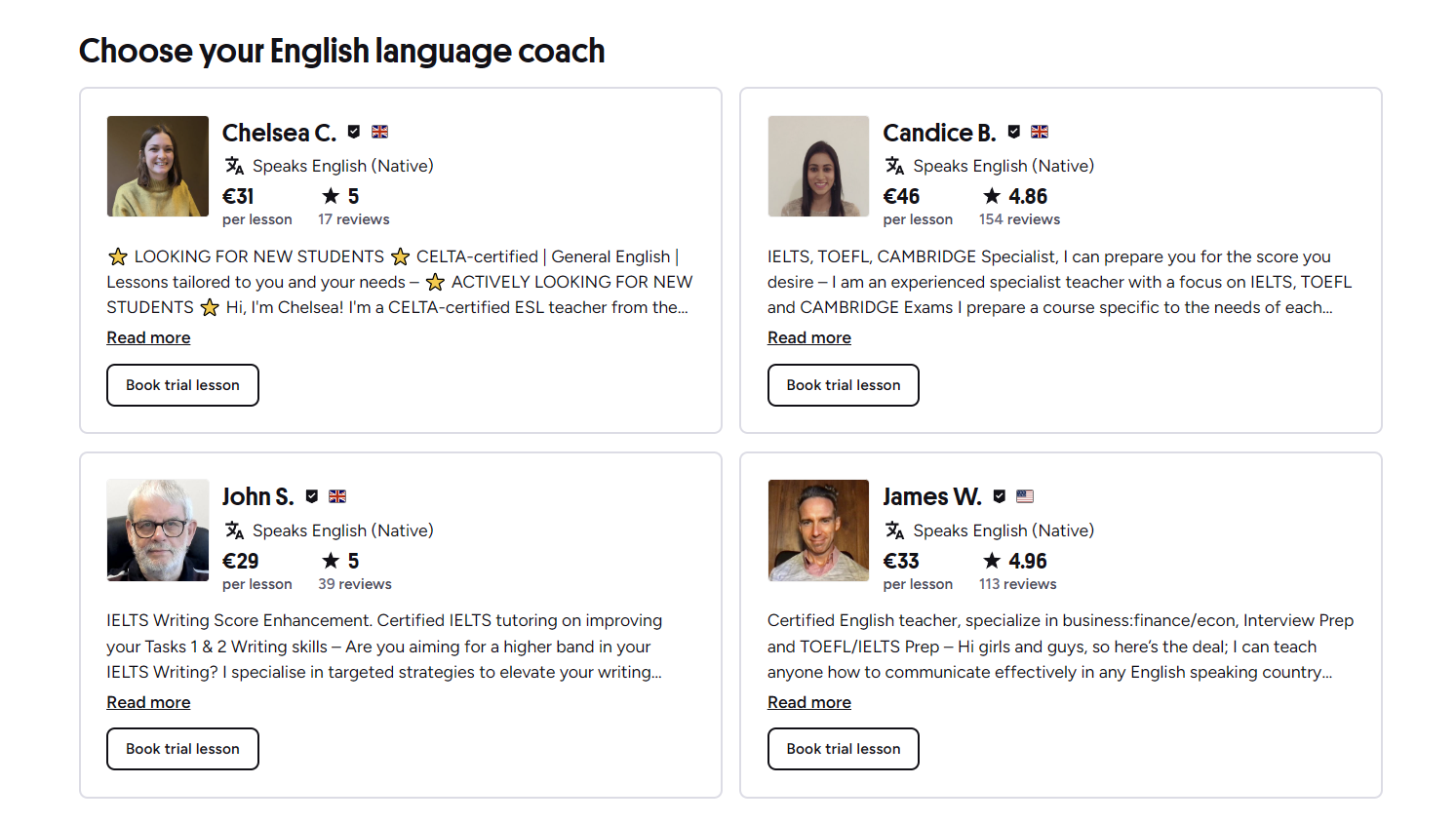
The filter system is the primary tool for narrowing the pool. You can sort by price range, tutor's native language, time zone, specialization (IELTS, business English, kids, beginners), and rating. Each profile shows a short video introduction, a written bio, student reviews, and a calendar of available slots. Pay attention to the video: it gives a sense of the tutor's accent, energy, and clarity. Reviews are generally reliable but tend to cluster around 4.8–5.0 stars, so read the written comments for nuance — punctuality, preparation, adaptability.
- Define your goal first: exam prep, fluency, business writing, pronunciation, or general confidence.
- Use the specialization filter to surface tutors who explicitly teach that area.
- Check the tutor's time zone overlap with your preferred schedule before falling for a profile.
- Book trial lessons with 2–3 tutors to compare teaching styles in real time.
- Look for tutors who ask about your level and goals in the first message — it signals a structured approach.
A common mistake is choosing solely on price. The cheapest tutors may be newer to the platform or teaching part-time without formal training. That can work fine for conversation practice, but if you need grammar explanations, error correction, or a curriculum, you will likely progress faster with someone who charges mid-range or higher and has relevant certifications (CELTA, TEFL, TESOL) or years of experience teaching your specific need.
Preply English Tutor Prices and Subscription Options
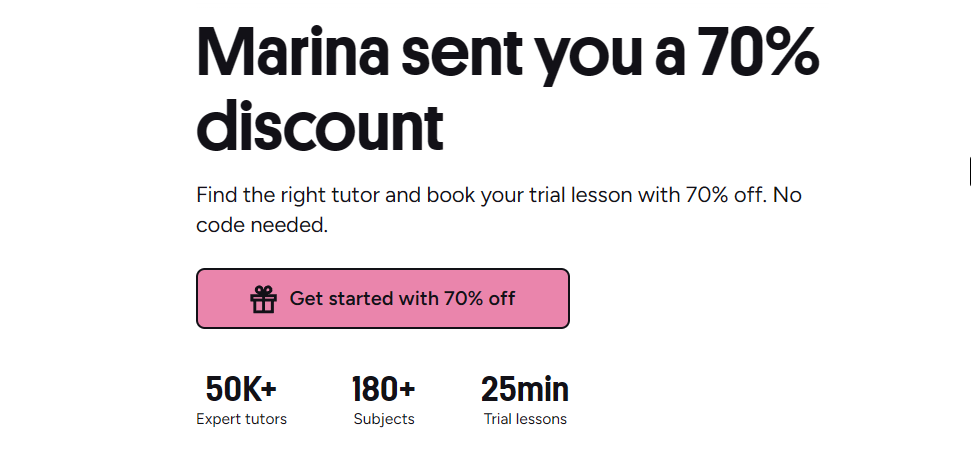
Pricing on Preply is not fixed. Tutors set their own hourly rates, and the platform adds its commission on top of what the tutor receives. As of early 2024, typical ranges for English tutors are: $10–$18 per hour for newer or non-native tutors, $18–$30 for experienced non-native or native tutors without specialized certifications, and $30–$60+ for native speakers with CELTA/DELTA, exam expertise, or niche business backgrounds. Trial lessons are often 50% off the tutor's regular rate, sometimes as low as $1–$3 during promotional periods.
Scroll horizontally to see all columns
| Tutor Profile | Price Range | Best For |
|---|---|---|
| Newer tutors, non-native | $10–$18 | Casual conversation, basic practice |
| Experienced non-native / native without certs | $18–$30 | General fluency, grammar, vocabulary |
| Certified native speakers (CELTA, TEFL) | $30–$45 | Exam prep (IELTS, TOEFL), business English |
| Specialized experts (legal, medical, academic) | $45–$70+ | Professional English, advanced writing |
Subscriptions reduce the per-lesson cost by about 5–10% compared to buying the same number of hours as a one-time package. They also lock in your weekly time slot, which is valuable if your tutor's calendar fills quickly. The trade-off is rigidity: you pay for the slot whether you attend or not, and changing the recurring time requires tutor agreement. If your schedule shifts week to week, a pay-as-you-go package may be cheaper overall despite the higher per-lesson rate.
Using the Preply English Level Test
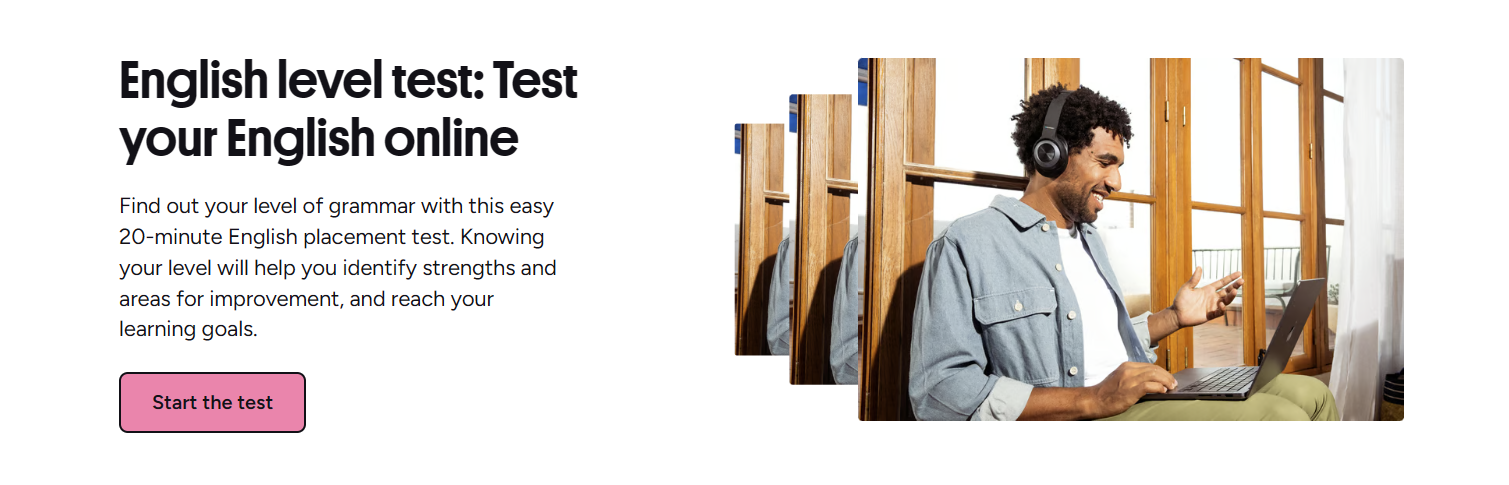
Preply offers a free adaptive English level test that takes roughly 20 minutes. It assesses grammar, vocabulary, reading, and listening, then maps your result to the CEFR scale (A1–C2). The test is not a substitute for a tutor's diagnostic, but it gives a quick baseline and helps tutors prepare a relevant first lesson. You can retake it monthly to track progress. The algorithm adjusts difficulty based on your answers, so guessing randomly will skew the result.
After completing the test, Preply suggests tutors who specialize in your level. This is a useful starting point, but don't treat the label as definitive. A tutor's assessment during a trial lesson — especially a speaking evaluation — often reveals gaps the automated test misses, such as pronunciation habits or fossilized errors.
Lesson Formats and Scheduling Flexibility
Lessons are 50 minutes by default. You can book 60- or 90-minute sessions if the tutor offers them, but the platform's scheduling grid is built around the 50-minute block. The video classroom works in browser (Chrome, Firefox, Safari) and via the mobile apps. No external software is required. Features include a shared whiteboard, collaborative document editing, and the ability to record lessons (with tutor consent) for later review.
- Recurring weekly slots: best for consistency; subscription required for the discount.
- One-off bookings: flexible but subject to tutor availability; no subscription discount.
- Package purchases: 4, 8, 12, 20, or 40 hours; hours expire after 12 months if unused.
- Time zone handling: the platform shows tutor availability in your local time automatically.
- Cancellation policy: free cancellation up to 4 hours before; within 4 hours, the lesson is charged.
The mobile app mirrors the desktop experience but is handy for quick rescheduling or reviewing vocabulary flashcards between lessons. Some tutors assign homework through Preply's built-in exercises or external links; the app sends push notifications for upcoming lessons and tutor messages. If you travel frequently, the app's offline mode lets you review saved materials without a connection.
What Makes a Good English Tutor on Preply
Beyond credentials, the day-to-day experience hinges on soft skills and teaching habits. A good tutor prepares a loose plan for each lesson, balances speaking time (you should talk 60–70%), corrects errors without interrupting flow, and provides a brief summary with notes after class. They also adapt when a topic isn't working. Red flags: the tutor dominates the conversation, relies entirely on free conversation with no structure, cancels frequently, or pushes to move communication off-platform (which violates Preply's terms and removes payment protection).
The best tutor isn't the one with the most certificates — it's the one who listens to your mistakes and knows which three to fix this week.
Many tutors offer a structured curriculum for common goals (IELTS speaking, business emails, phrasal verbs). Ask for a sample lesson plan or syllabus during the trial. If they improvise entirely, that's fine for chat practice but less efficient for measurable progress. Also check whether they use the platform's homework and progress tracking tools — some do, some prefer Google Docs or Notion. Consistency in tools reduces friction.
Preply for Business English and Corporate Training
Preply Business is a separate product tier aimed at companies. It adds admin dashboards, centralized billing, progress reporting, and dedicated account management. Employees get access to the same tutor pool but with corporate pricing (volume discounts) and the ability to assign learning paths. For individual professionals, the regular platform works fine — just filter for 'Business English' specialization. Many tutors in that category have corporate backgrounds and can tailor lessons to presentations, negotiations, or industry-specific vocabulary.
If your employer reimburses language learning, ask for an invoice. Preply generates PDF invoices for each package purchase, which most finance departments accept. The business tier also supports team analytics — useful if you're managing a group — but for a single learner, the standard account with a business-specialized tutor is usually sufficient and cheaper.
Tutor Requirements and Quality Controls
Preply's vetting process for tutors is lighter than some competitors. Applicants submit a profile, a short video, and proof of identity. There is no mandatory teaching demo or certification check. The platform relies on student ratings and its own algorithm to surface quality. Tutors with consistently low ratings or policy violations are removed, but the bar for entry is low. This means you will find highly qualified professionals alongside enthusiastic amateurs. The review system is your main quality signal — but remember that new tutors have few reviews, so a 5.0 from three students is less informative than a 4.8 from 200.
Preply also runs a 'Super Tutor' badge program for top-rated, high-retention tutors. The badge appears on profiles and in search results. It correlates with quality but is not a guarantee — some excellent tutors haven't been on the platform long enough to earn it. Use it as a tiebreaker, not a primary filter.
Comparing Preply with Other Tutoring Platforms
The main alternatives are italki, Verbling, Cambly, and traditional online schools like EF or Berlitz. Each has a different model. italki is similar to Preply but takes a flat 15% commission (lower for tutors, sometimes lower prices for students) and offers a community section for language exchange. Verbling requires tutors to have teaching credentials, so the floor is higher but the pool is smaller and rates tend to be higher. Cambly focuses on on-demand conversation with native speakers — no booking, no structure, pay by minute. Traditional schools provide curriculum and teachers but less scheduling freedom and higher cost.
Scroll horizontally to see all columns
| Platform | Model | Typical Rate (USD/hr) | Best For |
|---|---|---|---|
| Preply | Marketplace + subscription | $10–$60 | Structured lessons, exam prep, flexibility |
| italki | Marketplace + community | $8–$50 | Budget learners, language exchange |
| Verbling | Curated marketplace | $15–$70 | Credentialed teachers, consistent quality |
| Cambly | On-demand chat | $0.17–$0.33/min | Casual conversation, no scheduling |
| Traditional online school | Fixed curriculum + assigned teacher | $200–$500/month | Full program, accountability, certification |
If you want a structured course with a syllabus, progress tests, and a certificate, a traditional school or a platform with built-in courses (like Preply's own course library) may suit you better. If you want to hand-pick a tutor for a specific need — say, practicing medical English for an upcoming conference — the marketplace model wins. Many learners use both: a course for foundations and a tutor for speaking practice.
Managing Your Subscription and Lesson Credits
Preply's subscription system is where most billing confusion arises. When you subscribe, you commit to a weekly lesson at a set day and time. The platform charges your card every 4 weeks for the next block of lessons. If you need to skip a week, you must cancel that specific lesson at least 4 hours in advance — otherwise the credit is consumed. You can pause a subscription for up to 4 weeks per year, but only if you have no upcoming lessons scheduled. Unused package hours (from non-subscription purchases) expire after 12 months. Refunds for unused hours are possible within 30 days of purchase, minus any lessons taken, but subscription payments are generally non-refundable after the first charge.
A practical tip: if your schedule is irregular, buy a small package (4–8 hours) without subscribing. Use those hours to test tutors and find a rhythm. Once you have a regular slot with a tutor you like, switch to a subscription for the discount. You can always cancel the subscription later and revert to pay-as-you-go.
Progress Tracking and Learning Tools
Preply provides a progress dashboard that shows total hours, lessons completed, and a self-assessed CEFR level over time. Tutors can add lesson notes, vocabulary lists, and homework assignments that appear in the student's portal. The platform also hosts a library of self-study materials — grammar exercises, vocabulary sets, pronunciation drills — organized by level and topic. These are free for all users and can supplement live lessons. However, the tracking relies heavily on tutor input. If your tutor doesn't use the notes feature, the dashboard stays sparse.
For self-directed learners, the vocabulary tool uses spaced repetition. You can add words from lessons or the library, and the app schedules reviews. It's basic compared to dedicated apps like Anki but convenient because it lives inside the same ecosystem. The grammar guide and pronunciation exercises are similarly functional — good for quick reference, not a replacement for a structured course.
The platform gives you the tools, but the tutor decides whether they get used. A tutor who updates your vocabulary list after every lesson is doing half your review work for you.
Common Pitfalls and How to Avoid Them
New users often run into the same issues. Booking a trial with a tutor who then has no regular slots matching your schedule wastes the trial. Always check the tutor's recurring availability before booking. Another pitfall: assuming the trial lesson is a full diagnostic. Many tutors treat it as a casual chat. If you want a level assessment, say so when booking. Also, some tutors use the trial to upsell their own materials or external courses — Preply discourages this but enforcement is inconsistent.
- Check recurring availability before booking a trial.
- State your goal (assessment, curriculum, conversation) in the booking message.
- Keep communication on-platform until you've had at least 3 paid lessons.
- Screenshot the tutor's cancellation policy from their profile in case of disputes.
- Set a calendar reminder for the 4-hour cancellation window.
Payment disputes are rare but happen. If a tutor no-shows, Preply usually refunds the lesson credit automatically. If a tutor cancels last-minute repeatedly, report it — the platform may penalize the tutor. For technical issues (audio, video), try switching browsers or the app before blaming the tutor. The classroom logs connection quality, which support can review.
Frequently Asked Questions
How much do Preply English tutors typically charge per hour?
Rates range from about $10 for newer tutors to $60+ for certified specialists. Most experienced tutors fall between $18 and $35 per hour.
Is the Preply English level test accurate?
It gives a reasonable CEFR estimate for grammar, vocabulary, and reading, but speaking and writing are not assessed. Treat it as a starting point, not a final placement.
Can I get a refund if I don't use my lesson credits?
Unused package hours can be refunded within 30 days of purchase, minus any lessons taken. Subscription payments are generally non-refundable after the first charge.
Do I need to subscribe to use Preply?
No. You can buy hour packages (4, 8, 12, etc.) without a subscription. Subscriptions give a small discount and guarantee a weekly slot.
What happens if my tutor cancels a lesson?
If the tutor cancels, the lesson credit is returned to your balance. If they cancel repeatedly, you can request a tutor change or contact support.
Are Preply tutors certified teachers?
Not all. Preply does not require certification. Many tutors have TEFL/CELTA, but others are native speakers without formal training. Filter for certifications if that matters to you.
Can I switch tutors after starting a subscription?
Yes, but you must cancel the current subscription (which ends the weekly slot) and start a new one with the new tutor. Any unused lessons in the current billing cycle are not transferred.
Final Assessment of Preply English Tutors
Preply works well if you know what you want and are willing to invest time in finding the right tutor. The platform's strengths are volume, flexibility, and the ability to match niche needs — business English, exam prep, kids, accent reduction — with specialists. The weaknesses are the variable tutor quality at the low end, the subscription rigidity, and the reliance on student reviews that tend to be inflated. For a motivated learner who treats tutoring as a partnership rather than a service, Preply is a solid tool. For someone expecting a plug-and-play course with guaranteed outcomes, a structured program may be a better fit. Try three trials, compare notes, and decide from there.